第 7 章 · 特殊结构
本章收录六个跨章节、考试和写作中最常考的结构:条件句、间接引语、比较结构、主谓一致、强调句、倒装句。它们不是新的语法层级,而是前面各章知识的综合运用。
7.1 条件句 Conditionals
Section titled “7.1 条件句 Conditionals”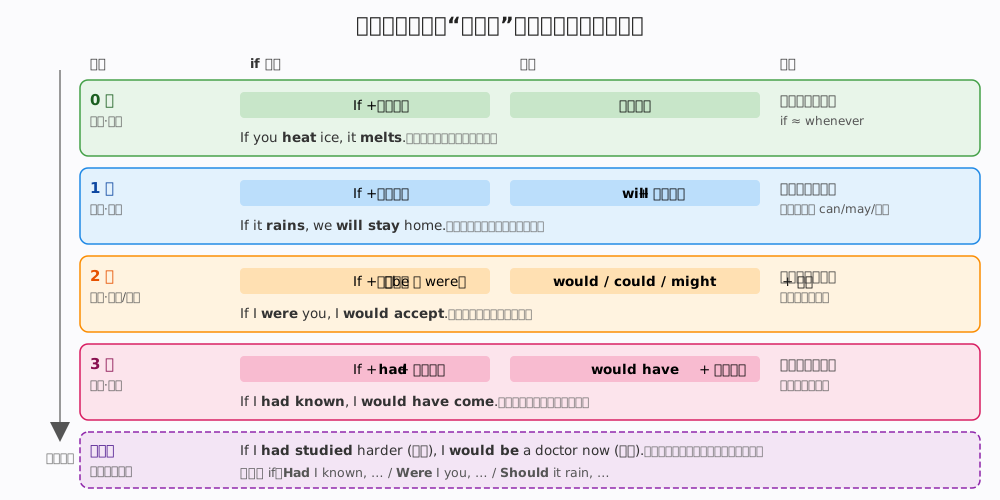
四种基本类型
Section titled “四种基本类型”| 类型 | 真实性 | if 从句 | 主句 | 例句 |
|---|---|---|---|---|
| 0 型 | 真实·普遍真理 | 一般现在 | 一般现在 | If you heat ice, it melts.(如果你加热冰,它就会融化。) |
| 1 型 | 真实·将来可能 | 一般现在 | will + 原形 | If it rains, we’ll stay home.(如果下雨,我们就待在家里。) |
| 2 型 | 非真实·现在/将来 | 一般过去(be → were) | would/could/might + 原形 | If I were you, I’d accept.(要是我是你,我就会接受。) / If I had time, I would help.(要是我有时间,我就会帮忙。) |
| 3 型 | 非真实·过去 | had + 过去分词 | would/could/might + have + 过去分词 | If I had known, I would have come.(要是我早知道,我就来了。) |
记忆口诀:越不真实,动词越往过去退一格。
- 1 型主句可用 can / may / must / should / 祈使句:If you see him, tell him. If it’s sunny, we can go.(如果你见到他,就告诉他。如果天晴,我们就可以去。)
- 将来可能性较小的条件:(a) should + 原形 表“万一”,仍是真实条件,主句常用 will / 祈使句:If it should rain tomorrow, we’ll cancel the trip.(万一明天下雨,我们就取消行程。)(b) were to + 原形 表纯假设,主句用 would:If the sun were to rise in the west, I would still not believe him.(即使太阳从西边升起,我也不会相信他。)
- 混合型:从句与主句时间不同:
- 过去条件 → 现在结果:If I had taken the job (过去), I would be rich now (现在).(要是我当时接受了那份工作,我现在就富有了。)
- 现在条件 → 过去结果:If he were careful (一贯), he wouldn’t have made the mistake (过去).(要是他是个细心的人,他就不会犯那个错误了。)
- 省略 if 的倒装(正式):把 were / had / should 提到句首: Were I you, … / Had I known, … / Should it rain, … 完整例:Had I known, I would have come.(要是我早知道,我就来了。)
- 含蓄条件:without, but for, otherwise, or, with:But for your help, I would have failed.(要不是你的帮助,我早就失败了。) = If it hadn’t been for your help…
- unless = if … not;as long as / provided that / suppose 等见 6.5。
🔑 记忆:越不真实,动词越往过去退一格。省 if 只请三位:Were / Had / Should(只有这三个词能提前)。
真实与虚拟的区分
Section titled “真实与虚拟的区分”If he comes, I’ll tell him.(如果他来,我就告诉他。)(真实:他可能来) If he came, I would tell him.(要是他来了,我就会告诉他。)(虚拟:他大概不会来 / 纯假设) 两者都在谈将来;差别在于说话人认为可能性有多大。
7.2 直接引语与间接引语 Reported Speech
Section titled “7.2 直接引语与间接引语 Reported Speech”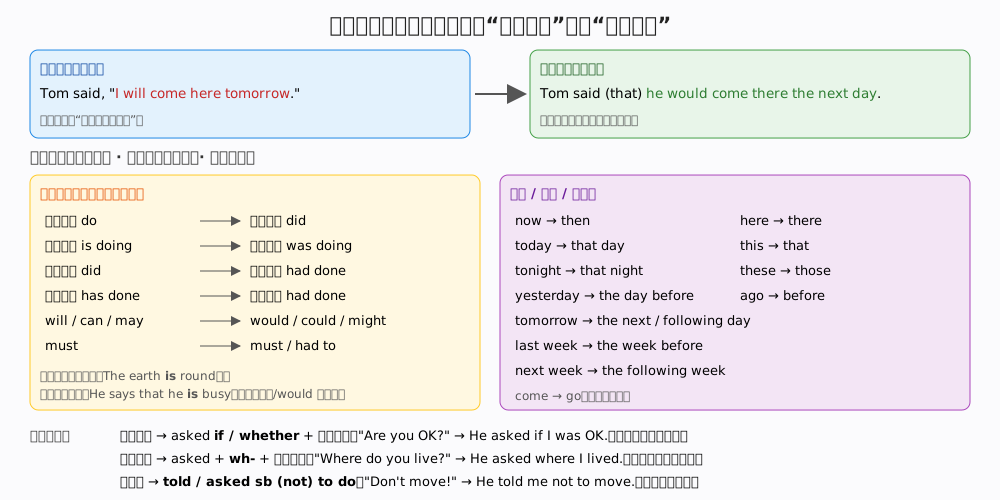
把别人的话转述时,说话的时间、地点、人称视角都变了,所以要做三种调整。
一、人称变化
Section titled “一、人称变化”按转述者的视角改:He said, “I love my job.” → He said (that) he loved his job.(他说他热爱他的工作。)
二、时态后退(主句为过去时)
Section titled “二、时态后退(主句为过去时)”| 直接引语 | 间接引语 |
|---|---|
| 一般现在 do | 一般过去 did |
| 现在进行 is doing | 过去进行 was doing |
| 现在完成 has done | 过去完成 had done |
| 一般过去 did | 过去完成 had done(口语常保持 did) |
| 过去进行 was doing | 过去完成进行 had been doing(或不变) |
| 过去完成 had done | 不变 |
| will / shall / can / may | would / should / could / might |
| must | must / had to |
| would / could / might / should / ought to | 不变 |
不后退的情况:
- 主句是现在时:He says he is busy.(他说他很忙。)
- 客观真理、自然规律:The teacher said the earth goes round the sun.(老师说地球绕着太阳转。)
- 转述时情况仍然成立(可不变):He said he lives in Paris.(他说他住在巴黎。)(现在还住)
- 虚拟语气不变:He said, “If I were you, I’d go.” → He said if he were me, he’d go.(他说要是他是我,他就会去。)
- 带具体过去时间的一般过去时可不变:He said he was born in 1990.(他说他 1990 年出生。)
🔑 记忆:三不退——真理不退、主句现在时不退、虚拟不退;“说话时仍成立”可不退。
三、时间、地点、指示词的变化
Section titled “三、时间、地点、指示词的变化”| 直接 | 间接 | 直接 | 间接 |
|---|---|---|---|
| now | then | here | there |
| today | that day | this / these | that / those |
| tonight | that night | come | go |
| yesterday | the day before / the previous day | ago | before |
| tomorrow | the next day / the following day | last week | the week before / the previous week |
| next week | the following week |
(如果转述发生在同一天同一地点,这些词不必改。)
四、句型的转换
Section titled “四、句型的转换”| 直接引语类型 | 间接引语 | 例 |
|---|---|---|
| 陈述句 | said / told sb (that) + 陈述 | “I’m tired,” he said. → He said (that) he was tired.(他说他累了。) |
| 一般疑问句 | asked (sb) if / whether + 陈述语序 | “Are you OK?” → He asked if I was OK.(他问我是否还好。) |
| 特殊疑问句 | asked (sb) + wh- + 陈述语序 | “Where do you live?” → He asked where I lived.(他问我住在哪里。) |
| 祈使句(命令) | told / ordered sb (not) to do | “Don’t move!” → He told me not to move.(他叫我别动。) |
| 祈使句(请求) | asked sb (not) to do | “Please help me.” → She asked me to help her.(她请我帮她。) |
| 建议 | suggested doing / suggested that … (should) do | “Let’s go.” → He suggested going / that we (should) go.(他建议我们去。) |
| 感叹句 | said (that) … | “What a wonderful day!” → She said what a wonderful day it was / She said (that) it was a wonderful day.(她说这一天真美好。) |
say vs tell:say sth (to sb);tell sb sth。He said me ✗。ask 后可直接跟人。
7.3 比较结构 Comparison
Section titled “7.3 比较结构 Comparison”| 等级 | 结构 | 例句 |
|---|---|---|
| 原级 | as + 形/副 + as;not so/as … as | He is as tall as his father. She isn’t as old as she looks.(他和他父亲一样高。她不像看上去那么老。) |
| 比较级 | 形/副-er / more + 形/副 + than | He is taller than me. This is more useful than that.(他比我高。这个比那个更有用。) |
| 最高级 | the + 形/副-est / most + 形/副 (+ of/in 范围) | He is the tallest in the class. She is the most careful of all.(他是班里最高的。她是所有人中最细心的。) |
常用比较句型
Section titled “常用比较句型”| 句型 | 例句 |
|---|---|
| 倍数:twice / three times + as … as / the + 名词 + of | This room is twice as large as that one. = twice the size of that one(这个房间是那个房间的两倍大。)注:twice 不与比较级连用(✗ twice larger than);three times 及以上可用比较级:three times larger than |
| 比较级前的程度词:much, far, a lot, a little, a bit, even, still, slightly, no, any | He is much taller. Is she any better?(他高得多。她好些了吗?) |
| the + 比较级, the + 比较级 | The more you practise, the better you get.(你练得越多,就越熟练。) |
| 比较级 + and + 比较级 | It’s getting colder and colder. More and more people …(天气越来越冷了。越来越多的人……) |
| the + 比较级 + of the two | He is the taller of the two.(他是两人中较高的那个。) |
| 否定 + 比较级 = 最高级 | I have never seen a better film.(我从未看过比这更好的电影。) = the best film |
| no more than / not more than | no more than 仅仅(= only)/ not more than 不多于(= at most):He has no more than 10 dollars.(他只有 10 美元。)/ He has not more than 10 dollars.(他最多有 10 美元。) |
| more … than … 与其说…不如说 | He is more lazy than stupid.(他与其说是笨,不如说是懒。) |
| not so much … as … 与其说…不如说 | He is not so much a teacher as a friend.(他与其说是老师,不如说是朋友。) |
| as … as possible / as … as one can | Come as soon as possible.(尽快来。) |
| 最高级 + ever / that … have ever done | It’s the best film (that) I have ever seen.(这是我看过的最好的电影。) |
| 最高级前 the 的省略 | 副词最高级可不加 the:He runs fastest.(他跑得最快。);同一事物不同情况比较不加 the:The lake is deepest here.(这个湖在这里最深。) |
比较对象要对等
Section titled “比较对象要对等”The climate of Beijing is colder than Shanghai. ✗ → … than that of Shanghai. ✓(气候与气候比,不是气候与城市比)
比较级不能自身比较
Section titled “比较级不能自身比较”He is taller than anyone in his class. ✗(把自己也算进去了)→ … than anyone else in his class. ✓;或 … than any student in the other class.
🔑 记忆:比什么就和什么比(that of);和自己人比要加 else / other。not more than 只否定“多于”→ 最多;no more than 连分量一起否定 → 仅仅(= only)。
比较级的绝对用法
Section titled “比较级的绝对用法”the elder brother, higher education, the younger generation(不再比较,绝对用法);senior, junior, superior, inferior, prior(拉丁语来源的比较级,后接 to,不接 than):He is senior to me.(他比我资历老。)
7.4 主谓一致 Subject-Verb Agreement
Section titled “7.4 主谓一致 Subject-Verb Agreement”谓语动词的数与人称要与主语一致。三条原则:
原则一:语法一致(看形式)
Section titled “原则一:语法一致(看形式)”- 单数主语 → 单数谓语;复数主语 → 复数谓语。
- and 连接的两个名词:一般复数;但表同一人/物/概念时单数:Bread and butter is my breakfast. The writer and teacher is here.(黄油面包是我的早餐。那位作家兼老师在这里。)(一人,只有一个 the)
- each / every / no + 单数名词(即使 and 连接)→ 单数:Every boy and every girl is welcome.(每个男孩和每个女孩都受欢迎。)
- 动名词、不定式、从句作主语 → 单数:Reading is fun. What he said is true.(阅读很有趣。他说的话是真的。)
- 单个名词短语,后接 with / together with / as well as / along with / except / but / rather than / including → 看前面的主语:The teacher, as well as the students, was late.(不仅学生们,老师也迟到了。)
- many a + 单数名词 → 单数:Many a student has tried.(许多学生都尝试过。)
- more than one + 单数名词 → 单数:More than one student has failed.(不止一个学生不及格。)
- a number of + 复数 → 复数;the number of + 复数 → 单数:A number of students are absent. The number of students is 30.(许多学生缺席。学生人数是 30。)
- one of + 复数名词 + 定语从句:主句谓语与 one 一致(He is one of …);定语从句内的谓语与复数名词一致:He is one of the students who were late.(他是迟到的学生之一。)加 the only 后,从句谓语改与 one 一致:He is the only one of the students who was late.(他是学生中唯一迟到的人。)
🔑 记忆:有 the 是“数目”→ 单(the number of);无 the 是“许多”→ 复(a number of)。
原则二:意义一致(看含义)
Section titled “原则二:意义一致(看含义)”- 集体名词:family, team, class, government, committee, audience —— 整体单数,成员复数(英式更常用复数):The team is strong. The team are all tired.(这支球队很强。队员们都累了。)
- 恒复数:people, police, cattle:The police are here.(警察来了。)
- 恒单数:news, physics, maths, politics, economics(学科名), the United States(国名), Gulliver’s Travels(书名)
- 时间、金钱、距离、重量作整体 → 单数:Ten years is a long time. Two hundred dollars is enough.(十年是一段很长的时间。两百美元就够了。)
- 数学运算 → 单数:Two and two is / makes four.(二加二等于四。)
- 分数、百分数、most of / all of / some of / half of / plenty of / the rest of + 名词 → 看 of 后的名词:Two thirds of the land is desert. Most of the students are here.(三分之二的土地是沙漠。大多数学生都在这里。)
- the + 形容词:表一类人复数(the rich are),表抽象概念单数(the beautiful is)
- 不定代词:each, either, neither, another, everyone, somebody, nothing 等 → 单数;none 单复皆可(正式用单数);all 指人/物复数,指事单数
- what 引导的主语从句:通常单数,但表语为复数或 what 指复数时可复数:What we need are more teachers.(我们需要的是更多的教师。)
原则三:就近一致(看最近的名词)
Section titled “原则三:就近一致(看最近的名词)”以下结构谓语与靠近它的主语一致:
- there be:There is a book and two pens.(有一本书和两支钢笔。) / There are two pens and a book.(有两支钢笔和一本书。)
- or / either … or / neither … nor / not only … but also / not … but:Either you or I am wrong.(要么是你错了,要么是我错了。实际常改说 Either you are wrong or I am.)Neither the teacher nor the students know.(老师和学生们都不知道。)
- here / there 开头的倒装句同理。
主谓一致速查
Section titled “主谓一致速查”语法一致 and 复数(同一人/物单数);each/every 单;动名词/从句主语单;as well as 看前 a number of 复 / the number of 单;one of…who 复 / the only one of…who 单意义一致 集体名词整体单成员复;people/police 复;news/physics 单;时间金钱整体单 分数/most of/half of 看 of 后;the rich 复就近一致 there be;or / either…or / neither…nor / not only…but also7.5 强调句 Emphasis
Section titled “7.5 强调句 Emphasis”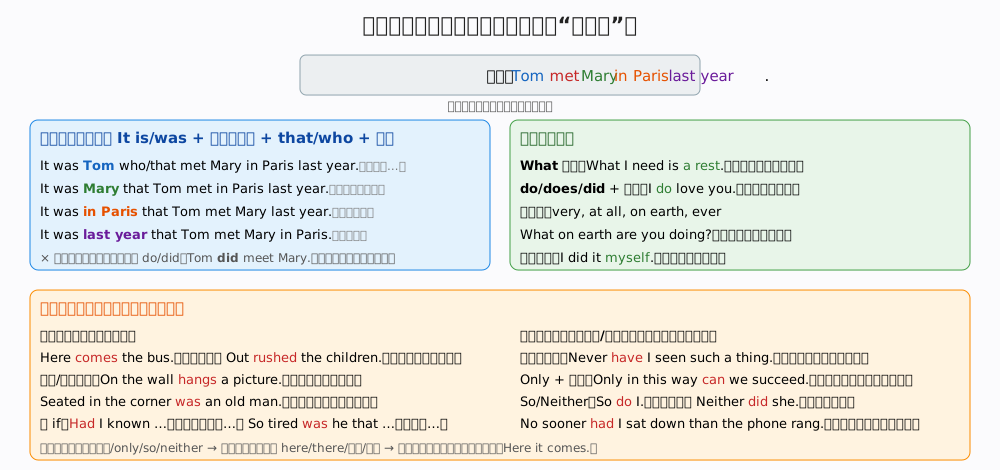
强调句型(分裂句)It is/was + 被强调部分 + that/who + 其余部分
Section titled “强调句型(分裂句)It is/was + 被强调部分 + that/who + 其余部分”- 可以强调主语、宾语、状语(时间、地点、原因、方式);不能强调谓语动词和表语。
- 强调人时可用 who 或 that(作主语时 who 最常见);其他成分一律 that。
- 判断法:去掉 It is … that,剩下的部分能还原成完整句子 → 是强调句;否则是主语从句或其他句型。
- It was in 2010 that we met.(正是在 2010 年我们相遇的。) → 去掉后 In 2010 we met.(2010 年我们相遇了。) ✓ 强调句
- It was in 2010 when we met.(合乎语法,但不是标准强调句;考试与正式写作一律用 that)
- It is clear that he is right.(很明显他是对的。) → 去掉后 Clear he is right ✗ 不是强调句,是形式主语
- 时态:It is 对应现在,It was 对应过去。
- 疑问形式:Is it … that …? / Wh- + is it that …? — Who was it that called? Why is it that you’re late?(到底是谁打的电话?你到底为什么迟到?)
- 强调 not … until:It was not until midnight that he came back.(直到午夜他才回来。)
🔑 记忆:强调句只搬名词性成分和状语,谓语和表语搬不动;去掉 It is … that 还能还原成完整句才是强调句。
其他强调手段
Section titled “其他强调手段”| 手段 | 例句 |
|---|---|
| 助动词 do/does/did + 原形 | I do hope you’ll come. He did finish it.(我真的希望你能来。他确实完成了。) |
| 假分裂句 What … is … | What I need is a rest. What he did was (to) leave.(我需要的是休息。他所做的就是离开。) |
| 强调词 | very, at all, on earth, ever, in the world, whatever:What on earth are you doing? I don’t like it at all.(你到底在干什么?我一点也不喜欢它。) |
| 反身代词 | I did it myself. The king himself came.(这是我自己做的。国王亲自来了。) |
| 重复 | It’s very, very cold.(天非常非常冷。) |
| 倒装(见 7.6) | Never have I seen such a thing.(我从未见过这样的事。) |
7.6 倒装句 Inversion
Section titled “7.6 倒装句 Inversion”英语正常语序是“主语 + 谓语”。倒装是把谓语(或其一部分)放到主语前,有两类:
完全倒装:整个谓语动词提前
Section titled “完全倒装:整个谓语动词提前”| 情况 | 例句 |
|---|---|
| here / there / now / then + 动词(come, go, be, live) | Here comes the bus. There goes the bell. Then came the storm.(公交车来了。铃响了。接着暴风雨来了。) |
| 表地点/方位的状语开头(out, in, up, down, away, on the wall …) | Out rushed the children. On the wall hangs a picture.(孩子们冲了出去。墙上挂着一幅画。) |
| 表语(形容词、分词、介词短语)开头 | Gone are the days. Seated in the corner was an old man. Present at the meeting were many experts.(那些日子已经过去了。角落里坐着一位老人。出席会议的有许多专家。) |
| such 作表语开头 | Such was the result.(结果就是如此。) |
完全倒装中主语是代词时不倒装:Here it comes. Away they went.(它来了。他们走了。)
部分倒装:只把助动词 / 情态动词 / be 提到主语前(其余照旧,像一般疑问句)
Section titled “部分倒装:只把助动词 / 情态动词 / be 提到主语前(其余照旧,像一般疑问句)”| 情况 | 例句 |
|---|---|
| 否定词或半否定词开头:never, seldom, hardly, scarcely, rarely, little, not a / not a single + 名词, nowhere, by no means, in no way, at no time, not until, under no circumstances | Never have I seen such a thing. Little did he know. Not until yesterday did I hear it.(我从未见过这样的事。他一点也不知道。直到昨天我才听说这件事。)Not a word did he say.(他一个字也没说。) |
| only + 状语(副词、介词短语、从句)开头 | Only then did I understand. Only in this way can we succeed. Only when he returned did we learn the truth.(只有到那时我才明白。只有这样我们才能成功。只有当他回来时我们才知道真相。)(only 修饰主语不倒装:Only Tom knows. 只有汤姆知道。) |
| so / neither / nor 表“也/也不” | — I like it. — So do I. / — I don’t. — Neither do I.(——我喜欢它。——我也喜欢。/ ——我不喜欢。——我也不喜欢。)(so + 主语 + 助动词 不倒装,表“确实如此”:— He is clever. — So he is. ——他很聪明。——他确实很聪明。) |
| so / such … that 中 so/such 部分开头 | So fast did he run that no one could catch him.(他跑得如此快,没人能追上他。)Such was his surprise that he couldn’t speak.(他惊讶得说不出话来。——such 作表语提前时是完全倒装) |
| not only … but also 中 not only 开头 | Not only did he come, but he also helped.(他不仅来了,还帮了忙。)(but 后不倒装) |
| hardly / scarcely … when;no sooner … than | Hardly had I arrived when it rained. No sooner had he left than she came.(我刚到就下雨了。他刚离开她就来了。)(主句过去完成,从句一般过去) |
| 省略 if 的虚拟条件句:were / had / should 开头 | Had I known, … Were I you, … Should it rain, … |
| as / though 引导的让步从句(严格说是表语 / 状语前置,主谓顺序不变) | Child as he is, he knows a lot.(他虽然是个孩子,却懂得很多。)Much as I like it, I can’t buy it.(尽管我很喜欢它,却不能买。) |
| 疑问句、感叹句 | May you succeed! How can you say that?(祝你成功!你怎么能这么说?) |
| often / many a time / well 等副词开头(少见) | Many a time has he helped us.(他多次帮助过我们。) |
- 句首是否定词 / only + 状语 / so-neither-nor / not until → 部分倒装(借助动词)
- 句首是 here-there / 方位副词 / 表语 → 完全倒装(整个谓语前移;主语为代词不倒装)
- 句首是 had / were / should 且无 if → 虚拟条件的倒装
🔑 记忆:否定 / only / so 开头 → 借(借助动词到主语前);地点 / 表语 / here-there 开头 → 搬(整个谓语搬到主语前);主语是代词 → 不搬。
7.7 易错点
Section titled “7.7 易错点”| 错误 | 正确 | 原因 |
|---|---|---|
| If I would have known, … | If I had known, … | if 从句中不用 would |
| He asked me where did I live. | He asked me where I lived.(他问我住在哪里。) | 间接引语陈述语序 |
| He said me that … | He told me that … / He said to me that … | say 不直接接人 |
| The population of China is larger than India. | … than that of India. | 比较对象对等 |
| He is taller than any student in his class. | … than any other student … | 排除自己 |
| Ten years are a long time. | Ten years is a long time.(十年是一段很长的时间。) | 时间整体单数 |
| The number of students are increasing. | … is increasing. | the number of 单数 |
| It was yesterday when I met him.(想强调时不合规范) | It was yesterday that I met him.(正是昨天我遇见了他。) | 强调句用 that |
| Only Tom did know it. | Only Tom knew it.(只有汤姆知道这件事。) | only 修饰主语不倒装 |
| Here comes it. | Here it comes.(它来了。) | 代词主语不完全倒装 |
| Not only he came, but also he helped. | Not only did he come, but he also helped.(他不仅来了,还帮了忙。) | not only 句首部分倒装 |
| No sooner I had arrived than … | No sooner had I arrived than … | no sooner 句首部分倒装 |
7.8 速查表
Section titled “7.8 速查表”条件句 0 现在→现在 | 1 现在→will | 2 过去(were)→would | 3 had done→would have done | 混合 倒装省 if:Were / Had / Should 开头;含蓄条件 but for / otherwise / without间接引语 人称改 · 时态退一格(真理/现在时主句不退) · 时间地点词改 · 疑问句陈述语序 · 祈使 tell sb to do比较 as…as / -er than / the -est;倍数 twice as…as;the more…the more;比较对象对等;any other主谓一致 语法一致(形式) · 意义一致(含义) · 就近一致(there be / or / neither…nor)强调 It is/was + 强调部分 + that/who(不能强调谓语);do 强调;What 从句倒装 完全:here/there/方位/表语开头,代词主语不倒装 部分:否定词/only+状语/so-neither/so…that/not only/hardly…when/省 if 开头