第 5 章 · 非谓语动词
一句话:一个分句只有一个谓语动词,其余动词必须“降级”为 to do / doing / done,去充当名词、形容词或副词的角色。
5.1 一张图看懂
Section titled “5.1 一张图看懂”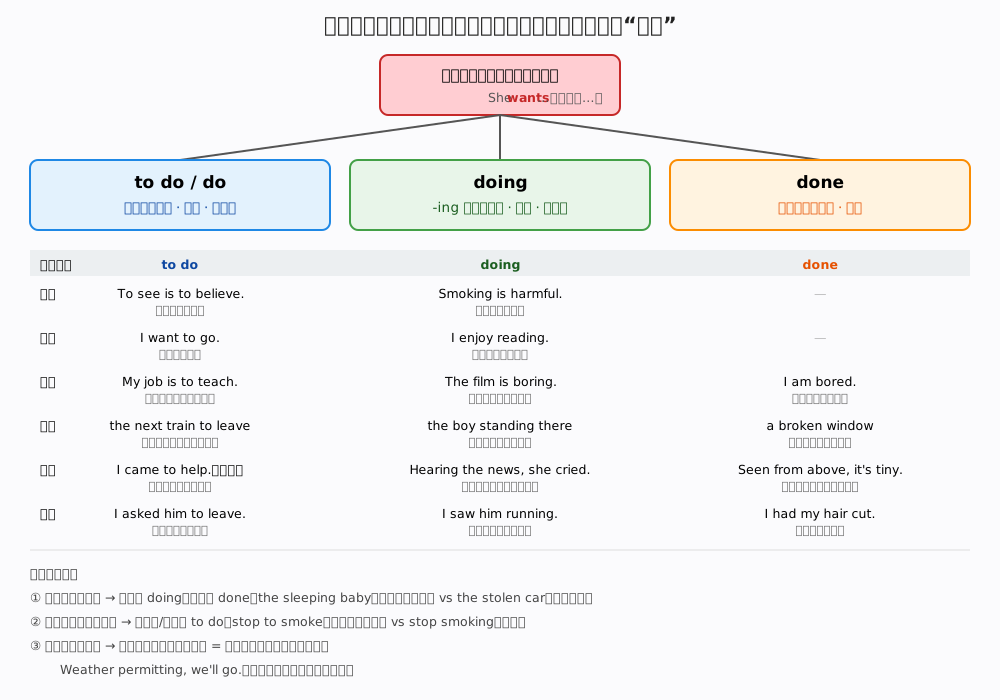
为什么需要非谓语
Section titled “为什么需要非谓语”比较:
- She wants something. She goes home.(她想要某样东西。她回家。——两个句子,两个谓语)
- She wants to go home.(她想回家。)(一个句子:wants 是谓语,to go 降级为宾语)
英语的规则:一个分句只能有一个限定动词(有时态的动词)。当一句话里要表达两个动作而又不想用连词或从句时,第二个动作就得变成非谓语。
三种形式的核心意义
Section titled “三种形式的核心意义”| 形式 | 名称 | 核心意义 | 与谓语动作的时间关系 |
|---|---|---|---|
| to do | 不定式 infinitive | 未发生 · 目的 · 将要 · 一次具体的动作 | 通常在谓语动作之后 |
| doing | 动名词 gerund / 现在分词 present participle | 主动 · 进行中 · 一般性、习惯性的动作 | 与谓语动作同时或泛指 |
| done | 过去分词 past participle | 被动 · 已完成 | 在谓语动作之前或表状态 |
三条判断线:
- 主动还是被动? 主动用 doing,被动用 done。
- 已发生还是未发生? 未发生、目的用 to do。
- 逻辑主语是谁? 非谓语的动作执行者默认是句子主语,否则要另加逻辑主语(for sb to do / 独立主格)。
🔑 记忆:to 向前,ing 主动进行,ed 被动完成——to do 看未来(目的 / 尚未做),doing 看现在(正在 / 主动),done 看过去或被动。
5.2 不定式 Infinitive
Section titled “5.2 不定式 Infinitive”| 主动 | 被动 | |
|---|---|---|
| 一般式 | to do | to be done |
| 进行式 | to be doing | — |
| 完成式 | to have done | to have been done |
| 完成进行式 | to have been doing | — |
- 完成式表示动作发生在谓语之前:He seems to have been ill.(他似乎病过。)
- 否定:not 放在 to 前:He told me not to go.(他叫我不要去。)
- 逻辑主语:for + sb + to do:It’s hard for me to say.(这我很难说。);形容词描述人品性格时用 of:It’s kind of you to help.(你能帮忙真是太好了。)
| 功能 | 例句 | 说明 |
|---|---|---|
| 主语 | To learn a language takes time.(学一门语言需要时间。) → It takes time to learn a language.(学一门语言需要时间。) | 常用 it 作形式主语 |
| 宾语 | I want to leave. She decided to stay.(我想离开。她决定留下。) | 见“只接不定式的动词” |
| 形式宾语 it + 宾补 + 真宾语 | I find it hard to understand him.(我觉得很难理解他。) | find / think / make / consider it + adj + to do |
| 表语 | My plan is to travel.(我的计划是去旅行。) | 主语常是 plan, aim, job, dream, purpose |
| 宾补 | I asked him to wait. She wants me to go.(我请他等一等。她想让我去。) | ask/tell/want/allow/expect/encourage/persuade/order/warn sb to do |
| 不带 to 的宾补 | Let him go. I saw her cross the street. They made me wait.(让他走。我看见她过了马路。他们让我等着。) | let/make/have;see/watch/hear/notice/feel。make 及感官动词变被动时补 to:He was made / seen to go.(他被迫 / 被看见离开。);let 的被动通常改用 be allowed to;have 无被动 |
| 定语(后置) | the best way to learn; something to eat; the first man to land on the moon(最好的学习方法;吃的东西;第一个登上月球的人) | 修饰 the first/last/only/next 或序数词修饰的名词;被修饰词与不定式常有动宾关系:a house to live in(介词不能丢) |
| 状语 · 目的 | He works hard to support his family.(他努力工作以养家。) / in order to / so as to | 否定:in order not to;so as to 不放句首 |
| 状语 · 结果 | He hurried, only to find the shop closed. She grew up to be a doctor.(他匆匆赶去,结果却发现商店关门了。她长大后成了一名医生。) | only to 表意外结果;too…to / enough to / so…as to |
| 状语 · 原因 | I’m glad to see you. She was surprised to hear the news.(见到你很高兴。听到这个消息她很惊讶。) | 情感形容词后 |
| 独立成分 | To be honest, I don’t like it. To tell the truth… To make matters worse…(老实说,我不喜欢它。说实话……更糟的是……) | 插入语 |
| 疑问词 + 不定式 | I don’t know what to do / where to go / how to use it.(我不知道该做什么 / 该去哪里 / 该怎么用它。) | 相当于名词性从句 |
只接不定式的动词(含 seem / appear / happen / tend 等系动词性动词)
Section titled “只接不定式的动词(含 seem / appear / happen / tend 等系动词性动词)”want, hope, wish, expect, decide, plan, agree, refuse, promise, offer, learn, manage, fail, afford, pretend, seem, appear, happen, tend, choose, ask, demand, determine, prepare, threaten, hesitate
记忆:多数表“打算、决定、希望、承诺”——面向未来的动词接不定式。
不带 to 的不定式(bare infinitive)
Section titled “不带 to 的不定式(bare infinitive)”- 情态动词后:can go
- let / make / have + sb + do:Let me try.(让我试试。)
- see / watch / hear / notice / feel + sb + do(看/听到整个过程;doing 表看到正在进行)
- had better, would rather, why not, cannot but:You’d better leave. Why not try?(你最好离开。为什么不试试呢?)
- help sb (to) do:to 可省
- but / except 前有 do 时:He did nothing but sleep.(他除了睡觉什么也没做。);前面无 do 时用 to:I have no choice but to go.(我别无选择,只能去。)
🔑 记忆:一感二听三让四看半帮助——一感 feel;二听 hear, listen to;三让 let, make, have;四看 see, watch, notice, observe;半帮助 help (to)。变被动时 to 回来(let 除外)。
分裂不定式与 to 的省略
Section titled “分裂不定式与 to 的省略”- 分裂不定式(to + 副词 + 动词)在现代英语中可以接受:to really understand。
- 前文出现过的动词可省略,只留 to:— Will you come? — I’d love to.(——你来吗?——我很愿意来。);但 be 或完成式的助动词要保留:He isn’t rich, but he wants to be.(他不富有,但他想变得富有。)
5.3 -ing 形式:动名词与现在分词
Section titled “5.3 -ing 形式:动名词与现在分词”英语的 -ing 形式一身两任:像名词用时叫动名词(gerund),像形容词或副词用时叫现在分词(present participle)。Huddleston & Pullum《剑桥英语语法》(2002) 把两者合称 gerund-participle。判断方法:看它在句中充当什么成分。
| 主动 | 被动 | |
|---|---|---|
| 一般式 | doing | being done |
| 完成式 | having done | having been done |
- 否定:not doing
- 逻辑主语:物主代词/名词所有格(正式)或宾格/名词(口语):I don’t mind his / him coming.(我不介意他来。);Do you mind my opening the window?(你介意我开窗吗?)
动名词(作名词)的功能
Section titled “动名词(作名词)的功能”| 功能 | 例句 |
|---|---|
| 主语 | Smoking is bad for health. Reading novels is fun.(吸烟有害健康。读小说很有趣。) |
| 宾语 | I enjoy swimming. He admitted having stolen the money.(我喜欢游泳。他承认偷了钱。) |
| 介词宾语 | She is good at dancing. Thank you for coming. I’m looking forward to seeing you.(她擅长跳舞。感谢你的到来。我期待见到你。) |
| 表语 | Her hobby is painting.(她的爱好是画画。) |
| 定语(表用途) | a swimming pool(游泳用的池子), a washing machine, a reading room |
只接 doing 的动词与短语
Section titled “只接 doing 的动词与短语”enjoy, mind, finish, avoid, suggest, consider, admit, deny, delay, postpone, practise, risk, escape, imagine, miss, keep (on), can’t help, can’t stand, give up, put off, feel like, look forward to, be worth, be busy, be used to, have difficulty/trouble (in)
记忆:多表“喜欢厌恶、完成中断、承认否认、建议考虑”——面向已存在或一般性的动作。
🔑 记忆:考虑建议盼原谅(consider, suggest, look forward to, excuse/pardon),承认推迟没得想(admit, delay/postpone/put off, imagine),避免错过继续练(avoid, miss, keep on, practise),否认完成停欣赏(deny, finish, stop/give up, enjoy/appreciate),禁不住冒险才算完(can’t help, risk)。
常见以介词 to 结尾的搭配后接 doing:be used to doing(习惯于)vs used to do(过去常常);look forward to doing;devote … to doing;object to doing;pay attention to doing;get down to doing;stick to doing。这些 to 是介词。
🔑 记忆:后面能放 it 的 to 是介词,接 doing:look forward to it ✓ → to doing;want to it ✗ → to do。
既可接 to do 又可接 doing 的动词——意义不同
Section titled “既可接 to do 又可接 doing 的动词——意义不同”| 动词 | + to do | + doing |
|---|---|---|
| stop | 停下来去做另一件事 He stopped to smoke.(他停下来抽了支烟。) | 停止做这件事 He stopped smoking.(他戒烟了。) |
| remember | 记得要去做(未做)Remember to lock the door.(记得要锁门。) | 记得做过 I remember locking it.(我记得锁过了。) |
| forget | 忘记要做 Don’t forget to call.(别忘了打电话。) | 忘记做过 I’ll never forget meeting her.(我永远忘不了见到她的那一刻。) |
| regret | 遗憾地要做(通知坏消息)I regret to tell you…(我很遗憾地告诉你……) | 后悔做过 I regret telling him.(我后悔告诉了他。) |
| try | 努力设法 Try to finish on time.(尽量按时完成。) | 尝试(看效果)Try restarting the computer.(试试重启电脑。) |
| mean | 打算 I meant to help.(我本想帮忙。) | 意味着 It means losing money.(这意味着亏钱。) |
| go on | 接着做另一件事 He went on to talk about…(他接着谈起……) | 继续做同一件事 He went on talking.(他继续说下去。) |
| need / want | 需要做(主语主动)I need to go.(我得走了。) | 需要被…(主动表被动)The car needs washing.(这车该洗了。) |
| like / love / hate / prefer | 习惯性选择、认为该做 I like to get up early.(我习惯早起。) | 爱好、享受 I like swimming.(我喜欢游泳。)(美式差别更小) |
| begin / start | It was beginning to rain.(开始下雨了。——进行时中);I began to understand.(我开始明白了。——后接静态动词) | It began raining.(开始下雨了。——一般情况两者同义) |
would like / love / hate / prefer 只接 to do:I’d like to swim now.(我现在想游泳。)
🔑 记忆:记忘悔停续(remember / forget / regret / stop / go on):to 朝前(还没做),ing 朝后(已做 / 正在做)。try、mean 单记:try to 努力 / try doing 试试看;mean to 打算 / mean doing 意味着。
现在分词(作形容词/副词)的功能
Section titled “现在分词(作形容词/副词)的功能”| 功能 | 例句 | 说明 |
|---|---|---|
| 定语(前置) | a sleeping baby; the rising sun; boiling water | 表主动、进行 |
| 定语(后置) | the boy standing there = the boy who is standing there(站在那里的男孩) | 分词短语后置,相当于定语从句 |
| 表语 | The film is interesting. The news is exciting.(这部电影很有趣。这个消息令人兴奋。) | 描述事物令人…(对比 -ed 描述人) |
| 宾补 | I saw him running. She kept me waiting. I found her crying.(我看见他正在跑。她让我一直等着。我发现她在哭。) | see/hear/watch/notice/feel/find/keep/leave/have/get sb doing |
| 状语(分词短语) | Hearing the news, she burst into tears.(听到这个消息,她大哭起来。)(时间) | 见下 |
分词作状语可表时间、原因、条件、让步、伴随、结果:
- 时间:Walking along the street, I met an old friend.(沿街走着,我遇到了一位老朋友。) = When I was walking…
- 原因:Being tired, he went to bed early.(因为累了,他早早上床睡了。) = Because he was tired…
- 条件:Working hard, you will succeed.(努力工作,你就会成功。) = If you work hard…
- 让步:Granted that you have a point, I still think you’re wrong.(即使承认你有道理,我仍认为你错了。)
- 伴随/方式:He sat there, reading a book.(他坐在那里看书。)
- 结果:The bus was late, causing us to miss the train.(公交车晚了,导致我们错过了火车。)
- 完成式表先于谓语:Having finished the work, he went home.(做完工作后,他回家了。)
- 连词 + 分词:When crossing the street, look out. Though defeated, he didn’t give up.(过马路时要小心。虽然被打败了,他并没有放弃。)
5.4 过去分词 Past Participle
Section titled “5.4 过去分词 Past Participle”被动(被…的)或完成(已…的)。及物动词的过去分词多表被动,不及物动词的过去分词表完成:a broken window(被打破的),fallen leaves(已落的叶), a retired teacher(已退休的)。
| 功能 | 例句 | 说明 |
|---|---|---|
| 定语(前置) | a broken cup; spoken English; a retired worker; the United States | |
| 定语(后置) | the letter written by Tom = the letter which was written by Tom;进行被动用 being done:the bridge being repaired = the bridge which is being repaired(正在被修的桥) | 分词短语后置 |
| 表语 | I am bored. The door is closed. She looks worried.(我感到无聊。门是关着的。她看起来很担心。) | 描述人的感受或状态 |
| 宾补 | I had my hair cut. She found the door locked. He made himself understood.(我理了发。她发现门锁着。他让别人听懂了他的话。) | have/get sth done 让某事被做 / 请人做某事 |
| 状语 | Seen from the hill, the city looks beautiful.(方式/条件:从山上看,这座城市很美。);Given more time, we could do better.(条件:如果多给些时间,我们能做得更好。);Shocked by the news, she fainted.(原因:被这个消息震惊,她昏倒了。) | 逻辑主语是句子主语,且承受动作 |
| 连词 + 过去分词 | Once published, the book sold well. Unless invited, don’t go. When asked, he said nothing.(一经出版,这本书就很畅销。除非受到邀请,否则不要去。被问到时,他什么也没说。) |
现在分词 vs 过去分词(最重要的区分)
Section titled “现在分词 vs 过去分词(最重要的区分)”| 现在分词 doing | 过去分词 done |
|---|---|
| 主动、进行 | 被动、完成 |
| the boy eating an apple(正在吃) | the apple eaten by the boy(被吃) |
| an exciting game(使人兴奋的) | excited fans(感到兴奋的) |
| Hearing the noise, he turned.(听到声音,他转过身来。)(他听) | Told the news, he turned pale.(被告知这个消息,他脸色苍白。——他被告知) |
| I saw him crossing.(我看见他正在过马路。)(正在过) | I heard my name called.(我听见有人叫我的名字。)(被叫) |
判断:分词的逻辑主语(被修饰的名词或句子主语)做这个动作 → doing;承受这个动作 → done。
🔑 记忆:谁做谁 -ing,谁受谁 -ed;事物 -ing 令人…,人 -ed 感到…(an exciting game / excited fans)。
5.5 独立主格结构 Absolute Construction
Section titled “5.5 独立主格结构 Absolute Construction”当分词的逻辑主语不是句子主语时,必须把它写出来,形成”名词/代词 + 非谓语(或形容词/副词/介词短语)“的结构,用逗号与主句隔开,作状语。
- The weather being fine, we went out.(天气很好,我们出去了。)(天气好 ≠ 我们)
- Weather permitting, we’ll go camping.(天气允许的话,我们就去野营。)
- The work done, they went home.(工作做完了,他们回家了。)
- He stood there, his hands in his pockets.(他站在那里,双手插在口袋里。)(介词短语)
- She came in, her face pale.(她走了进来,脸色苍白。)(形容词)
- with + 名词 + 非谓语(with 复合结构,更口语):With the work finished, they went home. He fell asleep with the light on.(工作完成后,他们回家了。他开着灯睡着了。)
悬垂分词(dangling participle)是常见错误:Walking down the street, the trees looked beautiful. ✗(树不会走路)→ Walking down the street, I saw beautiful trees.(沿街走着,我看到了美丽的树。) / As I walked down the street, the trees looked beautiful.(我沿街走时,树看起来很美。)
🔑 记忆:给分词找主人——把句子主语代入分词前读一遍,“主语 + 分词动作”说不通(the trees walking ✗)就换主语、加逻辑主语或改从句。
5.6 非谓语与从句的转换
Section titled “5.6 非谓语与从句的转换”非谓语动词本质上是从句的“压缩版”。掌握转换关系,读长句时能快速还原:
| 非谓语 | 对应从句 |
|---|---|
| the man standing there | the man who is standing there(定语从句) |
| the book written by him | the book which was written by him |
| the house being built over there(正在被建造的房子) | the house which is being built over there(进行 + 被动 → being done) |
| Seeing the dog, he ran.(看到狗,他跑了。) | When he saw the dog, he ran.(当他看到狗时,他跑了。)(状语从句) |
| I want to know.(我想知道。) | — (不定式作宾语无从句对应) |
| I don’t know what to do.(我不知道该做什么。) | I don’t know what I should do.(我不知道我该做什么。)(名词性从句) |
| It’s important for you to be on time.(你准时到很重要。) | It’s important that you (should) be on time.(你应当准时到,这很重要。)(should 型虚拟见 4.6) |
| I heard him sing.(我听见他唱歌。) | I heard that he sang.(我听说他唱了歌。)(意义有别) |
规律:去掉定语从句中的关系词和 be,剩下的分词即为后置定语(进行 → doing,被动 → done,进行被动 → being done)。
🔑 记忆:去关系词、去 be,留分词:who is standing → standing;which was written → written。
5.7 易错点
Section titled “5.7 易错点”| 错误 | 正确 | 原因 |
|---|---|---|
| I enjoy to swim. | I enjoy swimming.(我喜欢游泳。) | enjoy 只接 doing |
| He suggested to go. | He suggested going.(他建议去。) | suggest 只接 doing |
| I look forward to see you. | … to seeing you. | to 是介词 |
| I am used to get up early. | I am used to getting up early.(我习惯早起。) | be used to doing 习惯于 |
| Let him to go. | Let him go.(让他走。) | let 后不带 to |
| He was seen enter the room. | He was seen to enter the room.(有人看见他进了房间。) | 被动补回 to |
| I saw her to cross the street. | I saw her cross / crossing the street.(我看见她过了马路 / 正在过马路。) | 感官动词不带 to |
| Being tired, the work was left. | Being tired, I left the work unfinished.(因为累了,我没把工作做完。) | 悬垂分词 |
| the falling leaves on the ground | the fallen leaves on the ground | 已落的叶用 fallen |
| I’m very interesting in it. | I’m very interested in it.(我对它很感兴趣。) | 人的感受用 -ed |
| I stopped to smoke.(想说戒烟) | I stopped smoking.(我戒烟了。) | stop to do 停下去做 |
| Remember locking the door.(想说记得去锁) | Remember to lock the door.(记得去锁门。) | remember to do 记得要做 |
5.8 速查表
Section titled “5.8 速查表”形式 to do 未发生·目的·具体一次 被动 to be done 完成 to have done doing 主动·进行·一般性 被动 being done 完成 having done done 被动·完成(不及物:完成)
功能 主语 宾语 表语 → to do / doing(名词性) 定语 → doing 主动 / done 被动 / to do 将来 / the first … to do 状语 → doing 主动 / done 被动 / to do 目的·结果·原因 宾补 → want sb to do / let sb do / see sb do·doing / have sth done
只接 to do want hope decide plan agree refuse promise manage fail afford pretend只接 doing enjoy mind finish avoid suggest consider admit deny practise keep can't help两可意义异 stop remember forget regret try mean go on needto 是介词 look forward to / be used to / devote to / object to + doing
逻辑主语 默认 = 句子主语;不同则 for sb to do / sb's doing / 独立主格 / with 复合结构