第 6 章 · 并列句与三大从句
一句话:多个主谓结构可以平等地并列(并列句),也可以一个嵌入另一个(复杂句);嵌入的从句按功能分为名词性、定语、状语三大类。
6.1 一张图看懂
Section titled “6.1 一张图看懂”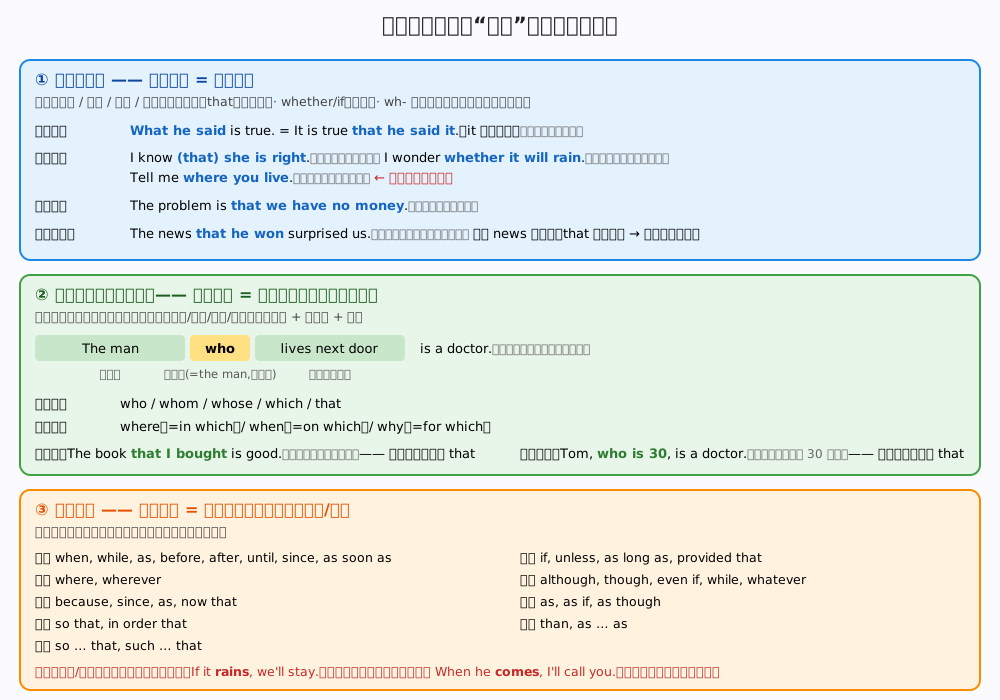
回顾 2.1 按结构的分类:
| 类型 | 结构 | 例 |
|---|---|---|
| 简单句 | 1 个主谓 | The rain stopped.(雨停了。) |
| 并列句 | 主谓 + 并列连词 + 主谓 | The rain stopped, and the sun came out.(雨停了,太阳出来了。) |
| 复杂句 | 主句 ⊃ 从句 | We went out after the rain stopped.(雨停后我们出去了。) |
| 并列复杂句 | 并列 + 从句 | I stayed in because it was raining, but Tom went out.(因为下雨我待在家里,但汤姆出去了。) |
判断从句类型的唯一问题:这个从句替代了主句里的什么?
- 替代一个名词(做主/宾/表/同位语)→ 名词性从句
- 跟在名词后面修饰它 → 定语从句(跟在名词后但说明其内容、that 不作成分的是同位语从句,见 6.3)
- 修饰谓语或全句(说明时间、原因、条件……)→ 状语从句
🔑 记忆:删除测试——删掉从句后主句残缺 → 名词性;主句完整且从句紧贴名词、不能移位 → 定语;主句完整且从句能整体移到句首或句末 → 状语。
6.2 并列句 Compound Sentence
Section titled “6.2 并列句 Compound Sentence”两个或多个地位平等的分句用并列连词连接,任一分句去掉后另一个仍能独立成句。
| 关系 | 连词 | 例句 |
|---|---|---|
| 并列/递进 | and, both…and, not only…but also, neither…nor | He sings, and she dances.(他唱歌,她跳舞。)Not only did he come, but he also helped.(他不仅来了,还帮了忙。)(not only 句首部分倒装) |
| 转折 | but, yet | He is rich, but he is unhappy.(他很有钱,但并不快乐。) |
| 选择 | or, either…or;otherwise 是副词,须用分号或句号:Hurry up; otherwise you’ll be late.(快点,否则你会迟到。) | Hurry up, or you’ll be late.(快点,否则你会迟到。) |
| 因果 | so(结果), for(原因,只放句中) | It was late, so we left.(天晚了,所以我们走了。)We left, for it was late.(我们走了,因为天晚了。) |
对比义的 while 是从属连词,见 6.5 让步。
要点
- 两个独立分句不能只用逗号连接(comma splice):It was late, we left. ✗ → 加连词、改分号、或拆成两句。
- 并列连词与从属连词不能叠用:Because it rained, so we stayed. ✗
- 分句主语相同时可省略第二个主语:He came in and (he) sat down.(他走进来坐下了。)
- neither…nor / either…or / not only…but also 连接主语时,谓语与靠近的主语一致(就近原则):Neither he nor I am wrong.(他和我都没有错。)
6.3 名词性从句 Nominal Clauses
Section titled “6.3 名词性从句 Nominal Clauses”整个从句相当于一个名词,可做主语、宾语、表语、同位语。从句内部一律用陈述语序。
| 引导词 | 含义 | 在从句中作成分? | 例 |
|---|---|---|---|
| that | 无意义,只起连接作用 | 否 | I know that he is right.(我知道他是对的。) |
| whether / if | 是否 | 否 | I wonder whether he will come.(我想知道他是否会来。) |
| who / whom / whose / what / which | 疑问代词,有意义 | 是(主/宾/定语) | I don’t know what he wants.(我不知道他想要什么。)(what 作 wants 的宾语) |
| whoever / whatever / whichever | 无论谁/什么 | 是 | Whoever comes is welcome.(无论谁来都受欢迎。) |
| when / where / why / how | 疑问副词,有意义 | 是(状语) | Tell me where you live.(告诉我你住在哪里。) |
whether vs if:if 一般只引导宾语从句;it 形式主语后置的主语从句口语中也可用 if:It doesn’t matter if he comes.(他来不来都没关系。);以下情况只能用 whether:主语从句、表语从句、同位语从句、介词后、不定式前(whether to go)、与 or not 直接相连(whether or not)。
🔑 记忆:if 只能当宾语;有 or not、介词、to、句首 → 只能 whether;拿不准用 whether 永不错。
that 的省略:宾语从句中 that 常省略(I think (that) he’s right 我认为他是对的。);主语从句(句首)、同位语从句中不能省;表语从句在正式文体中保留 that(口语 The trouble is (that)… 常省);宾语从句有多个并列时,第二个起的 that 不省。
- That he passed the exam surprised everyone.(他通过了考试,这让大家都很惊讶。)→ 更常用 it 作形式主语:It surprised everyone that he passed.(他通过了,这让大家都很惊讶。)
- Whether he will come is uncertain.(他是否会来还不确定。)→ It is uncertain whether he will come.(他是否会来还不确定。)
- What he said is true.(他说的话是真的。)(what 兼有“the thing that”的含义)
- 主语从句作主语时谓语一般用单数;what 从句指复数事物时可用复数:What we need are more teachers.(我们需要的是更多教师。)
- 常用 it 句型:It is clear / obvious / possible / said / reported / believed that …;It doesn’t matter whether …;It is no wonder that …
- 动词后:He said (that) he was busy. I don’t know if she’s coming. Ask him what he wants.(他说他很忙。我不知道她是否会来。问问他想要什么。)
- 介词后:It depends on whether it rains. We talked about what we should do.(这取决于是否下雨。我们讨论了应该做什么。)(介词后不用 that/if,that 从句只跟少数介词短语如 except that, in that)
- 形容词后:I’m sure (that) he’ll come. I’m afraid (that) I can’t.(我确信他会来。恐怕我不能。)
- 时态呼应:主句过去时,从句用过去范围的时态(见 4.3;间接引语中的应用见 7.2);客观真理除外。
- 否定转移:I don’t think he is right.(我认为他不对。)(不说 I think he isn’t right)
- 形式宾语 it:I think it strange that he didn’t come.(我觉得他没来很奇怪。)/ I’ll see to it that everything is ready.(我会确保一切准备就绪。)(介词后接 that 从句必须加 it)
The problem is that we have no money. The question is whether we should go. That’s why I’m late. This is where I was born.(问题是我们没有钱。问题是我们是否应该去。那就是我迟到的原因。这就是我出生的地方。) 主语常是抽象名词:reason, problem, question, fact, truth, idea。 The reason is that …(不说 because)。
紧跟抽象名词,说明其内容:The news that he won surprised us. The fact that the earth is round is known to all. I have no idea what he means. The question whether we should go is unsettled.(他获胜的消息让我们很惊讶。地球是圆的这一事实众所周知。我不知道他是什么意思。我们是否应该去这个问题尚未解决。) 常见名词:fact, news, idea, hope, belief, promise, suggestion, question, doubt, possibility, truth, conclusion。
同位语从句 vs 定语从句(同为名词 + that 从句):
| 同位语从句 | 定语从句 |
|---|---|
| that 不作成分,从句结构完整 | that 作成分(主语或宾语),从句缺成分 |
| 说明名词的内容 | 限定名词的范围 |
| The news that he won is true.(他获胜的消息是真的。——he won 完整) | The news that he told me is true.(他告诉我的消息是真的。——told me 缺宾语,that 是宾语) |
| that 不能省、不能换 which | 作宾语时 that 可省、可换 which |
名词性从句速查
Section titled “名词性从句速查”引导词 that 无义不作成分 / whether·if 是否 / wh- 有义作成分 / whoever 等语序 一律陈述语序that 省 只能在宾语从句中省if 限制 只在宾语从句;whether 万能,or not / 介词后 / 不定式前必用 whether形式主语 It is + adj/done + that … 形式宾语 think/find it + adj + that …6.4 定语从句 Relative Clauses
Section titled “6.4 定语从句 Relative Clauses”从句跟在一个名词(先行词 antecedent)之后修饰它,相当于形容词。由关系词引导:关系词有三个作用——① 连接主从句 ② 指代先行词 ③ 在从句中充当成分。
| 关系词 | 先行词 | 在从句中作 | 例句 |
|---|---|---|---|
| who | 人 | 主语(口语也作宾语) | the man who lives next door |
| whom | 人 | 宾语(正式;介词后必用) | the man whom I met / the man to whom I spoke |
| whose | 人/物 | 定语(后必须跟名词) | the girl whose father is a doctor / a house whose roof is red |
| which | 物 | 主语/宾语 | the book which I bought |
| that | 人/物 | 主语/宾语 | the book that I bought / the man that called |
| as | 人/物 | 主语/宾语(限于 such…as, the same…as, as 引导非限制从句) | such books as you like / As is known, … |
关系代词作宾语时可省略:the book (which/that) I bought。
关系副词(= 介词 + which)
Section titled “关系副词(= 介词 + which)”| 关系词 | 先行词 | 等于 | 例句 |
|---|---|---|---|
| when | 时间 | at/on/in which | the day when (= on which) we met |
| where | 地点 | at/in which | the house where (= in which) I was born |
| why | 原因(先行词 reason) | for which | the reason why he left |
判断用关系代词还是关系副词:看从句缺什么。缺主语或宾语 → 关系代词;不缺,只缺时间/地点/原因状语 → 关系副词。
- This is the house which/that I visited.(这就是我参观过的房子。)(visited 缺宾语)
- This is the house where I lived.(这就是我住过的房子。)(lived 不及物,不缺宾语)= the house in which I lived = the house which I lived in
🔑 记忆:把先行词放回从句——要加介词才通(I lived in the house)→ where / in which;不加介词就通(I visited the house)→ which / that。
限制性 vs 非限制性
Section titled “限制性 vs 非限制性”| 限制性定语从句 | 非限制性定语从句 |
|---|---|
| 无逗号,限定先行词范围,去掉后意思不完整 | 有逗号,补充说明,去掉后主句仍完整 |
| The students who work hard will pass.(努力学习的那些学生会通过。——只限努力的学生) | The students, who work hard, will pass.(这些学生都很努力,他们会通过。——指全部学生,从句只是补充) |
| 可用 that,作宾语可省 | 不能用 that,不能省略 |
| 先行词是普通名词 | 先行词可以是专有名词、整个主句 |
| — | He failed the exam, which surprised us.(他考试不及格,这让我们很惊讶。)(which 指代整个主句) |
🔑 记忆:逗号 = 括号——非限制从句像括号里的补充,随时可删;that 进不了括号(非限制不用 that,不可省);which 可以指代整个前句。
介词 + 关系代词
Section titled “介词 + 关系代词”- the pen with which I write = the pen (that/which) I write with
- 介词提前时只能用 which / whom(/ whose),不能用 that / who;不能省略。
- 介词的选择看从句动词的搭配或先行词的搭配:the speed at which…, the way in which…, the extent to which…
- 数量词 + of + which/whom:He has three sons, two of whom are doctors. There are ten books, most of which are new.(他有三个儿子,其中两个是医生。有十本书,其中大多数是新的。)
倾向用 that 与不能用 that
Section titled “倾向用 that 与不能用 that”| 倾向用 that | 不能用 that |
|---|---|
| 先行词是 all, everything, nothing, anything, little, much 等不定代词 | 非限制性定语从句 |
| 先行词被 the only, the very, the first, 最高级修饰 | 介词提前的定语从句 |
| 先行词既有人又有物 | 先行词是 that / those 时(用 which / who) |
| 主句已有 which/who 疑问词时,用 that 避免重复 |
the way / as / 特殊先行词
Section titled “the way / as / 特殊先行词”- the way (that / in which) he speaks(the way 后可用 that、in which 或省略,不用 how)
- He is not the man that he was.(他已不是从前的他了。)(表语用 that)
- the same … as(常用);the same … that 也可见,传统上说 that 强调“同一个”,实际差别不严格。
- such … as / so … as
- as 引导非限制从句可放句首:As we all know, …;which 不能放句首。
定语从句与非谓语的互换
Section titled “定语从句与非谓语的互换”the boy who is standing there = the boy standing there the letter which was written by him = the letter written by him the first person who arrived = the first person to arrive
定语从句速查
Section titled “定语从句速查”关系代词 who(人主) whom(人宾) whose(定语) which(物) that(人物) as(such/the same 后)关系副词 when(时间) where(地点) why(原因) = 介词 + which判断 从句缺主/宾 → 代词;不缺 → 副词限制性 无逗号;可用 that;作宾可省非限制性 有逗号;不用 that;which 可指整个主句介词提前 只能 which/whom;不能省6.5 状语从句 Adverbial Clauses
Section titled “6.5 状语从句 Adverbial Clauses”整个从句相当于一个副词,修饰主句的谓语或整个主句。由从属连词引导,位置灵活(句首时通常加逗号)。
时间状语从句
Section titled “时间状语从句”| 连词 | 含义 | 例句 / 要点 |
|---|---|---|
| when | 当…时(点或段) | When he came, I was reading.(他来时,我正在看书。)/ I was reading when he came.(我正在看书,这时他来了。)(when = and then 时不可换 while) |
| while | 在…期间(段,常用进行);而(对比) | While I was cooking, he was reading.(我做饭的时候,他在看书。) |
| as | 一边…一边;随着 | As time went by, … |
| before / after | 之前 / 之后 | Call me before you leave.(你离开之前给我打电话。) |
| until / till | 直到(肯定句:持续动作 + until;否定句:not … until 短暂动词) | Wait until I come back. He didn’t leave until she arrived.(等到我回来。直到她来了他才离开。) |
| since | 自从(主句常用完成时) | I’ve lived here since I was born.(我从出生起就一直住在这里。) |
| as soon as / the moment / the minute / immediately / directly / instantly(英式) | 一…就 | I’ll call you as soon as I arrive.(我一到就给你打电话。) |
| hardly / scarcely … when;no sooner … than | 刚…就(主句过去完成,常倒装) | Hardly had I sat down when the phone rang.(我刚坐下电话就响了。) |
| every time / each time / next time / the first time / by the time | 名词短语作连词 | By the time he arrived, we had left.(他到的时候,我们已经离开了。) |
时间从句用一般现在表将来:I’ll tell him when he comes.(他来的时候我会告诉他。)
地点状语从句
Section titled “地点状语从句”where, wherever, anywhere, everywhere(口语,多美式):Sit wherever you like. Where there is a will, there is a way.(你想坐哪儿就坐哪儿。有志者事竟成。)
原因状语从句
Section titled “原因状语从句”| 连词 | 语气 | 例句 |
|---|---|---|
| because | 最强,直接原因,可回答 why | I stayed because it rained.(我留下来是因为下雨了。) |
| since | 已知的原因,“既然” | Since you’re here, let’s start.(既然你来了,我们开始吧。) |
| as | 较弱,顺带提及 | As it was late, we left.(由于天晚了,我们就走了。) |
| now that | 既然(现在) | Now that you’ve finished, you can go.(既然你已经完成了,你可以走了。) |
| for | 并列连词,补充说明理由,只放后面 | He must be ill, for he looks pale.(他一定是病了,因为他脸色苍白。) |
because 从句可以单独回答 why,也可以做表语(It’s because …);不与 so 同用。
🔑 记忆:because 答 why 讲新因,since 既然说旧因,as 顺带弱一句,for 只跟在后不带头。
目的状语从句
Section titled “目的状语从句”- so that / in order that + 从句(常含 can/could/may/might/will/would):Speak louder so that everyone can hear.(说大声点,好让大家都能听见。)
- lest / for fear that / in case + (should) 原形 或陈述:Take an umbrella in case it rains.(带把伞,以防下雨。)
- in case 表预防(以防),不等于 if:Take a coat in case it gets cold.(带件外套,以防天冷。)≠ Take a coat if it gets cold.(天冷了就带件外套。)
- 简化:in order to / so as to + 不定式
结果状语从句
Section titled “结果状语从句”- so … that:so + 形容词/副词:He ran so fast that no one could catch him.(他跑得那么快,没有人能追上他。);so + many/few/much/little + 名词
- such … that:such (+a/an) + 形容词 + 名词:It was such a cold day that we stayed in.(那天太冷了,我们都待在家里。)
- so that(无逗号可表目的,有逗号多表结果):It rained heavily, so that the river rose.(雨下得很大,结果河水上涨了。)
- so / such 放句首要部分倒装:So fast did he run that …
条件状语从句
Section titled “条件状语从句”| 连词 | 含义 | 例句 |
|---|---|---|
| if | 如果 | If it rains, we’ll stay.(如果下雨,我们就留下。) |
| unless (= if … not) | 除非 | You’ll fail unless you work hard.(除非你努力,否则你会失败。) |
| as long as / so long as | 只要 | You can stay as long as you’re quiet.(只要你保持安静,就可以留下。) |
| provided (that) / providing (that) / on condition that | 只要,倘若 | You can borrow it provided you return it.(只要你归还,就可以借。) |
| suppose / supposing (that) | 假如 | Suppose it rains, what shall we do?(假如下雨,我们该怎么办?) |
| only if | 只有…才 | Only if you try will you succeed.(只有努力才会成功。——部分倒装) |
if only(要是…就好了)表愿望,用虚拟,见 4.6。
条件从句中用一般现在表将来;虚拟条件见 7.1。祈使句 + and/or 也表条件(见 2.4)。
让步状语从句
Section titled “让步状语从句”| 连词 | 例句 / 要点 |
|---|---|
| although / though | Although it was raining, we went out.(虽然在下雨,我们还是出去了。)(不与 but 同用;though 可放句末作副词) |
| even if / even though | Even if it rains, we’ll go.(即使下雨——不确定——我们也去。)Even though it was raining, we went.(尽管当时在下雨——事实——我们还是去了。)(even if 假设,even though 事实) |
| while | 尽管(多放句首)While I understand, I can’t agree.(尽管我理解,但我不能同意。) |
| as(倒装让步) | Child as he is, he knows a lot.(他虽然是个孩子,却知道很多。)(名词前无冠词)Try as he might, he failed.(尽管他很努力,还是失败了。) |
| whatever / whoever / however / whenever / wherever / no matter what … | However hard it is, I’ll try.(无论多难,我都会尝试。)= No matter how hard …(however + 形/副 紧跟) |
| whether … or | Whether you like it or not, you must go.(不管你喜不喜欢,你都必须去。) |
wh-ever 引导让步状语从句时可与 no matter wh- 互换;引导名词性从句时不能换:Whatever you say is right.(你说的一切都是对的。)(名词性)
🔑 记忆:even if 假设“即使”,even though 事实“尽管”;although 与 but 只留一个。
方式状语从句
Section titled “方式状语从句”- as:按照…的方式:Do as I say.(照我说的做。)
- as if / as though:好像(真实用陈述,非真实用虚拟):She looks as if she were ill.(她看起来好像病了。——其实没病,故用 were)
- the way(口语):Do it the way I showed you.(按我给你示范的方法做。)
比较状语从句
Section titled “比较状语从句”- than:He is taller than I (am).(他比我高。)
- as … as / not so (as) … as:She is as clever as her brother (is).(她和她哥哥一样聪明。)
- the more … the more:The more you read, the more you learn.(你读得越多,学到的就越多。)
- 详见 7.3。
状语从句的省略
Section titled “状语从句的省略”当从句主语与主句主语相同且从句含 be 时,可省略“主语 + be”: When (he was) young, he lived in Paris. If (it is) possible, come early. Though (he was) tired, he went on. Unless (you are) invited, don’t go.(他年轻时住在巴黎。如果可能,早点来。虽然累了,他还是继续。除非受到邀请,否则不要去。)
状语从句速查
Section titled “状语从句速查”时间 when while as before after until since as soon as by the time 从句用现在表将来地点 where wherever原因 because(强) since(既然) as(弱) now that for 是并列连词,只放后面目的 so that / in order that (+can/may) lest / in case结果 so + adj/adv + that; such + (a) adj + n + that条件 if unless as long as provided only if 从句用现在表将来让步 although/though (不加 but) even if/though while as(倒装) wh-ever = no matter wh-方式 as / as if / as though (虚拟)比较 than / as…as / the more…the more省略 从句主语 = 主句主语 且含 be 时,省"主语 + be"6.6 长难句分析法
Section titled “6.6 长难句分析法”- 找谓语动词(有时态的),有几个谓语就有几个分句。
- 找连接词(并列连词、从属连词、关系词),确定分句间关系。
- 划出从句边界:从连接词开始,到下一个分句的谓语之前。
- 确定从句类型:替代名词 → 名词性;修饰前面名词 → 定语;修饰动词/全句 → 状语。
- 剩下的就是主句骨架,按 1.4 的五种句型分析。
示例:The book that I borrowed from the library which opened last year, and which I haven’t finished yet, is due tomorrow.(我从去年开业的图书馆借的那本书——我还没读完——明天到期。)
- 谓语:borrowed, opened, haven’t finished, is due → 4 个分句
- 主句骨架:The book is due tomorrow.(SVC)
- that I borrowed from the library:定语从句修饰 book
- which opened last year:定语从句修饰 library
- , and which I haven’t finished yet,:非限制性定语从句修饰 book(and 把它与前面的限制性从句并列,明确其先行词是 book 而非 library)
6.7 易错点
Section titled “6.7 易错点”| 错误 | 正确 | 原因 |
|---|---|---|
| I don’t know where does he live. | I don’t know where he lives.(我不知道他住在哪里。) | 名词性从句用陈述语序 |
| The reason is because … | The reason is that … | 表语从句用 that |
| It depends on if it rains. | It depends on whether it rains.(这取决于是否下雨。) | 介词后用 whether |
| This is the house which I lived. | … where I lived / in which I lived / which I lived in | live 不及物,缺地点状语 |
| Tom, that is my friend, is here. | Tom, who is my friend, is here.(汤姆在这里,他是我的朋友。) | 非限制从句不用 that |
| the pen with that I write | the pen with which I write | 介词后不用 that |
| He is the only one of the students who were late. | … who was late. | the only one 单数先行词 |
| He is one of the students who was late. | … who were late. | 先行词是 students |
| Although he is rich, but he is unhappy. | 删 but 或删 although | 连词不叠用 |
| If it will rain tomorrow, … | If it rains tomorrow, … | 条件从句用现在表将来 |
| Because he was ill, so he was absent. | 删 because 或删 so | 连词不叠用 |
| He didn’t come, that made me angry. | He didn’t come, which made me angry.(他没来,这让我很生气。) | 指代整个主句用 which |
🔑 记忆:one of … who:有 the only 看 one(单数),没有 the only 看复数名词(复数)。
6.8 速查表
Section titled “6.8 速查表”并列句 and but or so for yet nor;成对连词就近一致;不能只用逗号连两个分句(comma splice)名词性 主/宾/表/同位语;that 无义 whether 是否 wh- 有义;陈述语序;it 形式主语定语 先行词 + 关系词(在从句中作成分);who whom whose which that;when where why 限制性(无逗号可 that) / 非限制性(有逗号不用 that,which 可指全句)状语 时间/地点/原因/目的/结果/条件/让步/方式/比较;时间条件从句用现在表将来分析 数谓语 → 找连接词 → 划边界 → 定类型 → 主句骨架