第 4 章 · 动词系统:时态、语态、情态、语气
一句话:谓语动词通过“时态”说明时间、通过“语态”说明视角、通过“情态动词”说明态度、通过“语气”说明说话人把事情当作事实、命令还是假设。
这是英语语法最核心也最难的一章。四个维度可以叠加:The report might have been being written by then.(到那时,这份报告可能已在撰写之中。——情态 + 完成 + 进行 + 被动)——实际上很少全用,但理解叠加顺序有助于看懂任何谓语。
4.1 时态:一张图看懂
Section titled “4.1 时态:一张图看懂”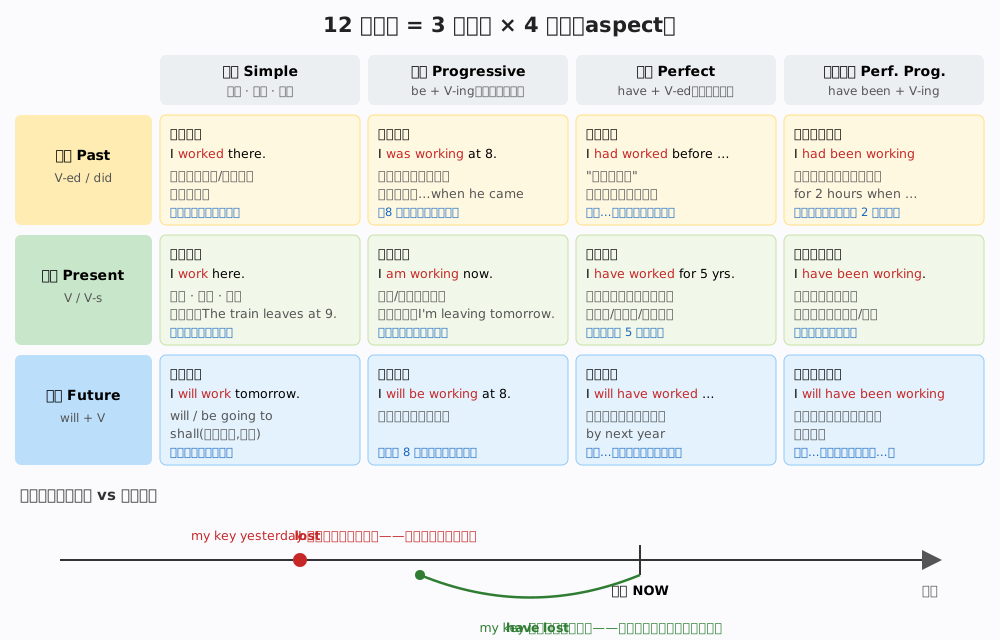
把 12 种时态拆成两个维度就好记了:
- 时间(tense):过去 / 现在 / 将来 —— 事情发生在时间轴的哪个位置
- 体(aspect):一般 / 进行 / 完成 / 完成进行 —— 说话人怎样看这件事(整体?正在进行?已完成?持续到某点?)
| 一般 | 进行 be + V-ing | 完成 have + V-ed | 完成进行 have been + V-ing | |
|---|---|---|---|---|
| 现在 | do / does | am/is/are doing | have/has done | have/has been doing |
| 过去 | did | was/were doing | had done | had been doing |
| 将来 | will do | will be doing | will have done | will have been doing |
(本章 V-ed 兼指规则动词的 -ed 形式和不规则动词的过去分词。)
学术说明:Huddleston & Pullum 指出英语只有现在和过去两个屈折时态,will 是情态动词。教学上说“12 种时态”是为了方便,本资料沿用。
🔑 记忆:谓语的助动词永远按 情态 → have(完成)→ be(进行)→ be(被动)→ 实义动词 排队,每个助动词决定后一个词的形态:情态 → 原形,have → 过去分词,be(进行) → -ing,be(被动) → 过去分词。might | have | been | being | written。
4.2 各时态详解
Section titled “4.2 各时态详解”一般现在时 Simple Present
Section titled “一般现在时 Simple Present”形式:V / V-s(第三人称单数加 -s/-es)
| 用法 | 例句 |
|---|---|
| 习惯、经常性动作(常配 always, usually, often, every day) | I get up at six.(我六点起床。) |
| 客观事实、真理 | Water boils at 100°C.(水在 100°C 沸腾。) |
| 现在的状态、感受、看法(静态动词) | She likes jazz. I think so.(她喜欢爵士乐。我认为是这样。) |
| 时刻表、日程(按计划将来发生) | The train leaves at 9:30.(火车 9:30 出发。) |
| 时间/条件状语从句中表将来 | I’ll call you when I arrive. If it rains, we’ll stay.(我到了就给你打电话。如果下雨,我们就留下。) |
| 剧情、新闻标题、现场解说 | Then the hero dies. Messi shoots and scores!(然后主角死了。梅西射门,进了!) |
一般过去时 Simple Past
Section titled “一般过去时 Simple Past”形式:V-ed(不规则动词见附录)
| 用法 | 例句 |
|---|---|
| 过去某时发生、已结束的动作(常配 yesterday, last week, in 2010, ago) | I met her in 2010.(我 2010 年认识了她。) |
| 过去的习惯(常配 often 等频度词;也可改用 used to / would,见下) | We often played here as kids.(我们小时候常在这里玩。) |
| 一连串过去的动作 | He came in, sat down and began to read.(他走进来,坐下,开始读书。) |
| 礼貌、委婉(形式过去,意义现在) | I wondered if you could help.(不知您能否帮个忙。) |
- used to 过去常常(现已不再):I used to smoke.(我过去常抽烟。)
- would 过去反复的动作(不能用于状态):Every summer we would go to the beach.(每年夏天我们都会去海边。——✗ We would live in Paris)
一般将来时 Simple Future
Section titled “一般将来时 Simple Future”| 形式 | 侧重 | 例句 |
|---|---|---|
| will + V | 预测;临时决定;意愿、承诺 | It will rain tomorrow. I’ll help you.(明天会下雨。我来帮你。) |
| be going to + V | 已有打算;有迹象即将发生 | I’m going to study abroad. Look at the clouds—it’s going to rain.(我打算出国留学。看那些云——要下雨了。) |
| be + V-ing(现在进行) | 已安排好的计划(有时间地点) | I’m meeting Tom at 6.(我 6 点要和汤姆见面。) |
| 一般现在 | 时刻表 | The plane takes off at 8.(飞机 8 点起飞。) |
| be about to / be to | 即将 / 按计划、安排;正式的命令或要求 | The show is about to start. You are to report at 9.(演出即将开始。你须在 9 点报到。) |
| shall | 第一人称,正式或征求意见 | Shall we go?(我们走吧?) |
🔑 记忆:看“决定的时间”——说话时才决定 → will;说话前已决定或已有迹象 → be going to;已敲定时间地点 → be doing;固定时刻表 → 一般现在。
现在进行时 Present Progressive
Section titled “现在进行时 Present Progressive”形式:am / is / are + V-ing
| 用法 | 例句 |
|---|---|
| 此刻正在进行 | She is talking on the phone.(她正在打电话。) |
| 现阶段在做(不一定此刻) | I am reading a novel by Dickens.(我最近在读一本狄更斯的小说。) |
| 已确定的近期计划 | We are leaving tomorrow.(我们明天就走。) |
| 反复发生、带情绪(配 always) | He is always complaining.(他总是在抱怨。) |
| 变化中的趋势 | Prices are rising.(物价正在上涨。) |
不用进行时的静态动词:know, believe, understand, remember, want, need, like, love, hate, belong, own, contain, seem, exist。注意:I’m loving it(我就喜欢)是刻意的口语/广告用法。have 表“拥有”不用进行时,表“经历/吃”可以:I’m having lunch.(我正在吃午饭。)
-ing 拼写:make → making;sit → sitting;lie → lying;die → dying;see → seeing。
过去进行时 Past Progressive
Section titled “过去进行时 Past Progressive”形式:was / were + V-ing
- 过去某一刻正在进行:At 8 last night I was watching TV.(昨晚 8 点我正在看电视。)
- 作背景,被另一动作打断:I was walking home when it started to rain.(我正走回家时,开始下雨了。——长动作用进行,短动作用一般过去)
- 两个同时进行:While I was cooking, he was reading.(我做饭的时候,他在看书。)
将来进行时 Future Progressive
Section titled “将来进行时 Future Progressive”形式:will be + V-ing。将来某一刻正在进行:This time tomorrow I will be flying to Paris.(明天这个时候我将正在飞往巴黎。)也用于委婉询问计划:Will you be using the car tonight?(你今晚会用车吗?)
现在完成时 Present Perfect
Section titled “现在完成时 Present Perfect”形式:have / has + V-ed(过去分词)
核心含义:过去发生,但和现在有关系。 三种典型情况:
| 情况 | 说明 | 例句 | 常见搭配 |
|---|---|---|---|
| 已完成,有现在结果 | 强调“现在怎样了” | I have lost my key.(我把钥匙弄丢了。——现在没钥匙) | already, just, yet, ever, never, recently |
| 持续到现在 | 从过去开始一直到现在 | I have lived here for 10 years.(我在这里已经住了 10 年了。) | for + 时段,since + 时点,so far, up to now |
| 经历 | 到现在为止做过没做过 | Have you ever been to Japan?(你去过日本吗?) | ever, never, before, once, twice, … times |
与一般过去时的关键区别:
| 一般过去 | 现在完成 |
|---|---|
| 关心“过去发生了什么”,与现在无关 | 关心“对现在有什么影响” |
| 可以带明确的过去时间(yesterday, in 2010, ago) | 不能带已结束的过去时间(yesterday, in 2010, ago, last week);包含现在的时间(today, this week, recently)可以 |
| I saw the film last week.(我上周看了这部电影。) | I have seen the film.(我已经看过这部电影了。——所以现在知道剧情) |
| He lived here for ten years.(他在这里住过十年。——现在不住了) | He has lived here for ten years.(他在这里已经住了十年了。——现在还住) |
🔑 记忆:问“现在怎样了”→ 现在完成;问“那时发生了什么”→ 一般过去。句中出现已结束的过去时间(yesterday / ago / in 2010 / last…)一律一般过去。for / since 只跟能持续的状态或动作(be dead, have, live, know)。
瞬间动词与 for/since:die, come, go, leave, buy, join, begin 等瞬间动词的肯定式完成时不能与表时段的 for/since 连用——否定式可以:He hasn’t left since Monday.(他从周一起就没离开过。)肯定式:He has died for two years. ✗ → He has been dead for two years.(他已经去世两年了。) / He died two years ago.(他两年前去世了。) / It is two years since he died.(他去世已有两年了。)
have been to / have gone to / have been in:
- He has been to Paris.(他去过巴黎。——已回来)
- He has gone to Paris.(他去巴黎了。——还没回)
- He has been in Paris for a week.(他在巴黎已经待了一周。)
过去完成时 Past Perfect
Section titled “过去完成时 Past Perfect”形式:had + V-ed。“过去的过去”——必须有一个过去的参照点。
- When I arrived, the train had left.(我到达时,火车已经开走了。——到达是过去,火车离开更早)
- By 2010 he had written three books.(到 2010 年,他已经写了三本书。)
- 常用于:间接引语:He said he had seen it.(他说他已经看过了。);虚拟条件句 3 型;It was the first time I had ever flown.(那是我第一次坐飞机。);hardly … when / no sooner … than。
如果两个动作按先后顺序用 before / after 连接,顺序已经清楚,可以都用一般过去:He left after he finished.(他做完之后就走了。)
将来完成时 Future Perfect
Section titled “将来完成时 Future Perfect”形式:will have + V-ed。到将来某点为止已完成:By next June I will have graduated.(到明年六月,我就已经毕业了。)常配 by + 将来时间。
现在完成进行时 Present Perfect Progressive
Section titled “现在完成进行时 Present Perfect Progressive”形式:have / has been + V-ing。从过去开始,一直持续到现在,强调动作本身的持续(可能仍在进行,或刚停)。
- I have been waiting for two hours.(我已经等了两个小时了。——还在等)
- It has been raining all day.(雨下了一整天了。)
- You look tired. — Yes, I have been working.(你看起来很累。——是啊,我一直在工作。刚停,看到结果)
与现在完成的差别:I have read the book.(读完了)vs I have been reading the book.(一直在读,没读完)。持续性动词(live, work, study, teach)两者差别很小。
过去完成进行时 / 将来完成进行时
Section titled “过去完成进行时 / 将来完成进行时”- had been + V-ing:到过去某点为止一直在做:She had been teaching for 20 years when she retired.(她退休时已经教了 20 年书了。)
- will have been + V-ing:到将来某点为止一直在做:By June I will have been working here for ten years.(到六月,我就在这里工作满十年了。——少用)
4.3 时态呼应与时间状语
Section titled “4.3 时态呼应与时间状语”🔑 记忆:主过从过,真理例外(主句过去时,从句退回过去范围;客观真理及仍成立的事实不退)。
- 主句为过去时,宾语从句通常也用过去范围内的时态(见 7.2 间接引语);客观真理以及说话时仍然成立的情况可不退。
- 时间/条件/让步状语从句中,用一般现在代替将来,用现在完成代替将来完成:When you have finished, call me.(你做完后给我打电话。)
- 常见时间状语与时态的配对:
| 时间状语 | 典型时态 |
|---|---|
| every day, usually, often | 一般现在 |
| now, at the moment, Look! Listen! | 现在进行 |
| yesterday, last…, …ago, in 1990, just now | 一般过去 |
| already, yet, just, ever, never, since…, for…, so far | 现在完成 |
| by the time…, before…(过去) | 过去完成 |
| tomorrow, next…, in two days | 一般将来 |
| by + 将来时间 | 将来完成 |
4.4 语态:主动与被动
Section titled “4.4 语态:主动与被动”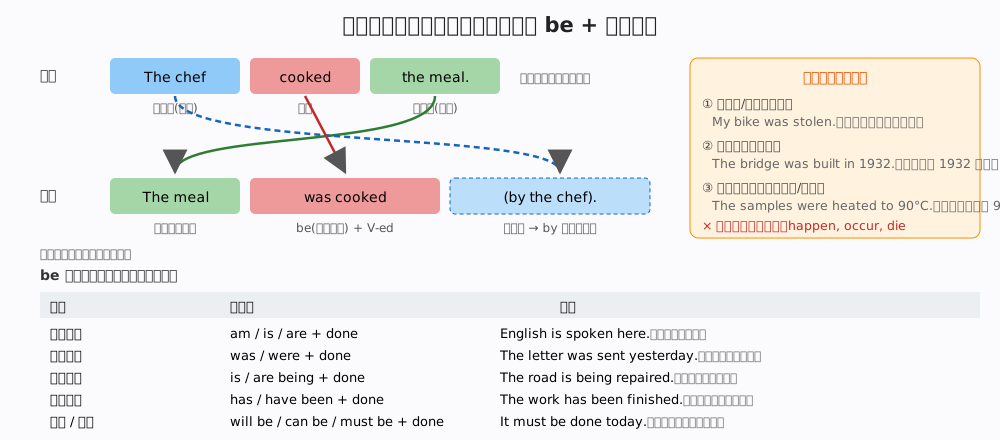
be + 过去分词,be 随时态、人称、数变化。施动者可用 by 引出(常省略)。
| 时态 | 主动 | 被动 |
|---|---|---|
| 一般现在 | writes | is written |
| 一般过去 | wrote | was written |
| 一般将来 | will write | will be written |
| 现在进行 | is writing | is being written |
| 过去进行 | was writing | was being written |
| 现在完成 | has written | has been written |
| 过去完成 | had written | had been written |
| 将来完成 | will have written | will have been written |
| 情态 | can write | can be written |
| 情态完成 | should have written | should have been written |
| 不定式 | to write | to be written |
| 动名词 | writing | being written |
(将来进行、完成进行的被动理论上存在,实际几乎不用。)
🔑 记忆:两步变被动——① 把主动句谓语里的实义动词换成 be,保留原来的时态和情态(has written → has been);② 把实义动词变过去分词接在后面(→ has been written)。
什么时候用被动
Section titled “什么时候用被动”- 不知道或不必说出施动者:My bike was stolen.(我的自行车被偷了。)
- 施动者显而易见:He was arrested.(他被逮捕了。——当然是警察)
- 强调承受者:The bridge was built in 1932.(这座桥建于 1932 年。)
- 客观正式的语体:The samples were heated to 90°C.(样品被加热至 90°C。)
- 避免句子头重脚轻,或保持主语一致。
- 双宾语的被动:两个宾语都可以做主语:He gave me a book.(他给了我一本书。) → I was given a book.(我得到了一本书。) / A book was given to me.(一本书被送给了我。)
- 宾补的被动:宾补留在原位:They made him captain.(他们让他当队长。) → He was made captain.(他被任命为队长。)
- 不带 to 的不定式作宾补,被动时加 to:They made me wait.(他们让我等着。) → I was made to wait.(我被迫等着。——see/hear/watch/make/help 等)。let 一般不用被动,改用 be allowed to:I was allowed to go.(我获准离开。)
- 短语动词整体被动:The meeting was put off. The baby is being looked after.(会议被推迟了。婴儿正被人照看着。——介词不能丢)
- get + 过去分词:口语,强调变化/意外:He got hurt. I got fired.(他受伤了。我被解雇了。)
- 主动形式表被动:某些及物动词用作不及物(中动结构),描述主语本身的特性:The book sells well. The cloth washes easily. The door won’t open.(这本书很畅销。这布料很好洗。这门打不开。)
- need / want / require + doing(主动形式表被动):The car needs washing.(这车需要洗了。) = needs to be washed
- be worth doing:The film is worth seeing.(这部电影值得一看。)
- 不能变被动:不及物动词(happen, occur, take place, belong to, appear, die);have(拥有), cost, lack, fit, suit, resemble, weigh(有…重)等关系动词;反身代词或相互代词做宾语。
- 感官系动词本身用主动形式表“被感知”(taste, smell, feel, look, sound),不能变被动:The soup tastes good.(这汤很好喝。)✗ is tasted
被动中 by 与 with
Section titled “被动中 by 与 with”The window was broken by a boy with a stone.(窗户被一个男孩用石头打破了。)—— by 引出施动者,with 引出工具。
4.5 情态动词 Modal Verbs
Section titled “4.5 情态动词 Modal Verbs”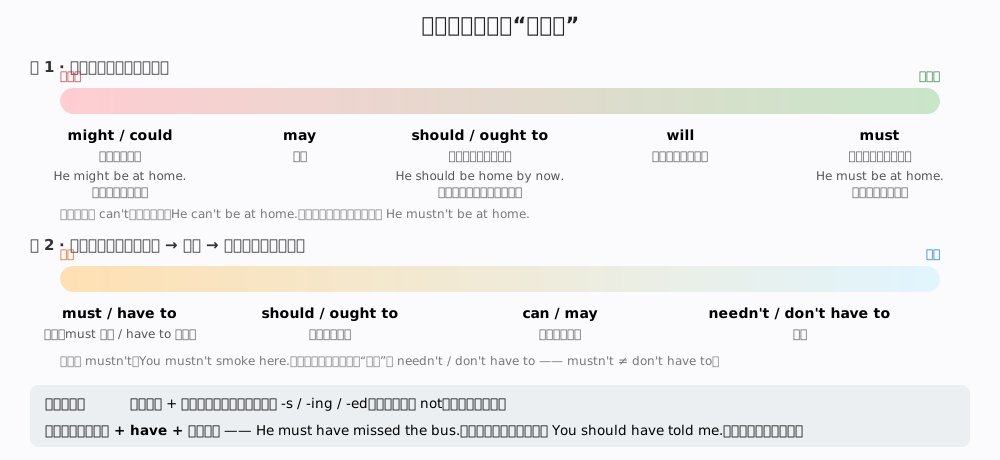
- 后接动词原形:can go, must be
- 无人称、数的变化:he can(✗ he cans)
- 否定直接加 not:cannot / can’t, must not, should not
- 疑问直接提前:Can you swim?(你会游泳吗?)
- 不能两个连用:will can ✗ → will be able to
- 表对过去的推测/评价:情态动词 + have + 过去分词
核心成员与含义
Section titled “核心成员与含义”每个情态动词大致有两类意义:道义意义(能力、许可、义务)与认识意义(推测、可能性)。
| 情态动词 | 道义意义 | 认识意义(推测) | 过去/其他形式 |
|---|---|---|---|
| can | 能力(I can swim 我会游泳);许可(Can I go? 我可以走了吗?);请求 | 理论可能性(Anyone can make mistakes 任何人都可能犯错);否定推测 can’t“不可能” | could / was able to(成功做到某一具体事) |
| could | 过去的能力;更礼貌的请求(Could you help? 您能帮个忙吗?) | 较小可能性(It could rain 可能会下雨) | could have done:本可以(却没) |
| may | 正式许可(May I come in? 我可以进来吗?);祝愿(May you succeed! 祝你成功!) | 可能,约 50%(He may be at home 他可能在家) | may have done:可能已经 |
| might | 更礼貌/委婉 | 可能性更小 | might have done:可能已经 / 本可以 |
| must | 必须(说话人的主观要求);mustn’t 禁止 | 一定(很有把握的推断);否定用 can’t | must have done:一定已经;“必须”的过去用 had to |
| have to | 必须(客观需要);don’t have to 不必 | (口语)一定:That has to be Tom.(那准是汤姆。) | had to;will have to |
| should | 应该(建议、义务);shouldn’t 不该 | 应该会(合理预期:He should be home by now 他现在应该到家了) | should have done:本应该(却没) |
| ought to | 应该(比 should 稍正式) | 同 should | ought to have done |
| will | 意愿、承诺(I’ll help 我来帮忙);习惯(He will sit there for hours 他总会在那儿坐上好几个小时) | 预测(It will rain 会下雨);确定的推断(That will be Tom 那准是汤姆) | — |
| would | 过去习惯;礼貌请求(Would you…?);意愿 | 假设(虚拟) | would have done:本会(虚拟) |
| shall | 第一人称将来(正式);征求意见(Shall we…?);法律条文中的“应” | — | — |
| need(情态用法) | 需要,多用于否定/疑问:You needn’t go. Need I go?(你不必去。我需要去吗?) | — | needn’t have done:本不必(却做了) |
| dare(情态用法) | 敢,多用于否定/疑问:How dare you!(你好大的胆子!) | — | — |
| used to | 过去常常(现已不再) | — | 否定 didn’t use to(常用)/ used not to(正式、较旧) |
🔑 记忆:推测把握——must 一定 · will 准是 · should 应该会 · may 可能 · might/could 也许;否定推测一律 can’t。
| 易混 A | 易混 B | |
|---|---|---|
| mustn’t 禁止 | vs | don’t have to / needn’t 不必 |
| must be 一定是 | vs | can’t be 不可能是(不说 mustn’t be——英式不用 mustn’t 表“不可能”;美式可说 He must not be home;can’t 两种变体通用) |
| could 过去有能力 | vs | was able to 过去成功做到了某件具体的事(否定式 couldn’t / wasn’t able to 两者通用) |
情态动词 + have done(对过去的态度)
Section titled “情态动词 + have done(对过去的态度)”| 结构 | 含义 | 例句 |
|---|---|---|
| must have done | 一定做了(推断) | The ground is wet. It must have rained.(地面是湿的。一定是下过雨了。) |
| can’t / couldn’t have done | 不可能做了 | He can’t have finished so soon.(他不可能这么快就做完了。) |
| may / might have done | 可能做了 | She may have missed the train.(她可能没赶上火车。) |
| could have done | 本可以(却没做)/ 可能做了 | You could have told me!(你本可以告诉我的!) |
| should / ought to have done | 本应该(却没做) | You should have seen a doctor.(你本应该去看医生的。) |
| shouldn’t have done | 本不该(却做了) | You shouldn’t have said that.(你本不该说那话的。) |
| needn’t have done | 本不必(却做了) | You needn’t have hurried.(你本不必这么赶的。) |
| would have done | 本会(虚拟) | I would have come if I’d known.(要是我早知道,我就会来了。) |
🔑 记忆:have done 只把时间推回过去,情态的态度不变——must have 一定已 · can’t have 不可能已 · may/might have 也许已 · could have 本可以(没)· should have 本应该(没)· shouldn’t have 本不该(却)· needn’t have 本不必(却)· would have 本会(虚拟)。
4.6 语气 Mood:陈述、祈使、虚拟
Section titled “4.6 语气 Mood:陈述、祈使、虚拟”- 陈述语气:把事情当事实说:He is here.(他在这儿。)
- 祈使语气:命令、请求:Be quiet.(安静。——见 2.4 祈使句)
- 虚拟语气:表示假设、愿望、建议,动词形式不与实际时间对应。
虚拟语气的三个来源
Section titled “虚拟语气的三个来源”英语虚拟语气有三种形态(Quirk 等 1985 的分类:mandative / formulaic / were-subjunctive),教学上常合称“虚拟语气”。Huddleston & Pullum 只把动词原形式称为 subjunctive,把 were 称为 irrealis,其余“退一格”的过去式视为过去时的非现实用法。
1. were-虚拟(非真实条件、愿望)
严格说只有 were 是独立的虚拟形式,其余是过去式 / 过去完成式的“非现实”用法,教学上统称“退一格”。if 从句与 wish 等结构中,用过去形式表现在、过去完成形式表过去,即“动词往过去退一格”。详见 7.1 条件句。
| 时间 | 从句 / wish 后 | 主句 |
|---|---|---|
| 与现在相反 | 一般过去(be 用 were) | would / could / might + 原形 |
| 与过去相反 | had + 过去分词 | would / could / might + have + 过去分词 |
| 与将来相反(可能性小) | 一般过去 / should + 原形 / were to + 原形 | would + 原形 |
- If I were you, I would accept.(如果我是你,我就会接受。)
- I wish I were taller.(我要是再高一点就好了。) / I wish I had studied harder.(我当初要是更用功就好了。) / I wish you would stop smoking.(我希望你能把烟戒了。)
- would rather + 从句:I’d rather you came tomorrow.(我宁愿你明天来。)
- as if / as though:He talks as if he knew everything.(他说起话来好像什么都知道似的。——说话人认为并非如此;若认为可能属实,则用陈述语气:as if he knows)
- It’s (high) time + 过去式:It’s time we left.(我们该走了。)
- if only:If only I had known!(我当时要是知道就好了!)
2. 动词原形虚拟(建议、命令、要求)—— mandative subjunctive
表示建议、命令、要求、坚持的动词/名词/形容词后的 that 从句,用动词原形(美式标准形式:that he go)或 should + 原形(英式更常用);英式口语中也可用陈述式(that he goes / went)。
- 动词:suggest, propose, recommend, advise, demand, require, request, order, command, insist, urge, ask
- I suggest that he (should) go at once.(我建议他马上去。)
- They demanded that the law be changed.(他们要求修改这项法律。)
- 名词:suggestion, proposal, demand, requirement, order, recommendation
- His suggestion that we (should) leave was accepted.(他提出我们离开的建议被采纳了。)
- 形容词(It is + adj + that):important, necessary, essential, vital, desirable, imperative, advisable
- It is essential that everyone (should) be present.(每个人都必须出席。)
注意:strange, natural, surprising, odd 等评价性形容词后的 should 是“情感 should”(putative should),只能用 should,不能省成原形:It’s strange that he should say so.(他竟然这么说,真奇怪。)
🔑 记忆:接 (should) 原形的动词——“一坚持、二命令、三建议、四要求”:insist | order, command | suggest, propose, recommend, advise | demand, require, request, ask, urge。
注意:insist 表“坚持说(事实)”、suggest 表“表明”时用陈述语气:He insisted that he was innocent. The evidence suggests that he is lying.(他坚持说自己是无辜的。证据表明他在撒谎。)
3. 固定套语虚拟
God bless you! Long live the King! So be it. Heaven forbid!(上帝保佑你!国王万岁!就这样吧。但愿不会!)
常见虚拟结构汇总
Section titled “常见虚拟结构汇总”| 结构 | 例句 |
|---|---|
| if 非真实条件 | If I had wings, I would fly.(要是我有翅膀,我就会飞。) |
| wish / if only | I wish it were Sunday.(今天要是星期天就好了。) |
| would rather (that) | I’d rather you didn’t smoke.(我宁愿你不抽烟。) |
| as if / as though | She acts as if she owned the place.(她表现得好像这地方是她的一样。) |
| It’s time (that) | It’s time you went to bed.(你该睡觉了。) |
| suggest / demand … that (should) V | He insisted that she (should) stay.(他坚持要她留下。) |
| It is important / necessary that (should) V | It’s vital that he (should) know.(他必须知道这件事。) |
| lest + (should) 原形 | He ran lest he (should) be late.(他跑了起来,以免迟到。) |
| in case / for fear that + 一般现在 或 should/might + 原形 | Take an umbrella in case it rains / should rain.(带把伞,以防下雨。) |
| without / but for + 名词(暗含条件) | But for your help, I would have failed.(要不是你帮忙,我早就失败了。) |
| otherwise / or(暗含条件) | I was busy; otherwise I would have come.(我当时很忙;否则我就来了。) |
🔑 记忆:虚拟三问——① 与哪个时间相反?现在 → 过去式(be 用 were);过去 → had done。② 主句永远 would/could/might,与过去相反再加 have done。③ wish / would rather / as if / It’s time / if only 后只有从句部分,照①退一格。
4.7 易错点
Section titled “4.7 易错点”| 错误 | 正确 | 原因 |
|---|---|---|
| I have seen him yesterday. | I saw him yesterday.(我昨天见到他了。) | 现在完成不与明确过去时间连用 |
| He has died for two years. | He has been dead for two years.(他已经去世两年了。) | 瞬间动词肯定式不与时段连用 |
| When I will arrive, I’ll call. | When I arrive, I’ll call.(我到了就打电话。) | 时间从句用现在表将来 |
| I am knowing the answer. | I know the answer.(我知道答案。) | 静态动词不用进行 |
| The accident was happened. | The accident happened.(事故发生了。) | 不及物动词无被动 |
| He was made wait. | He was made to wait.(他被迫等着。) | 被动中不定式补回 to |
| You mustn’t come if you don’t want to. | You don’t have to come…(你不必来……) | mustn’t 是禁止 |
| He mustn’t be at home. | He can’t be at home.(他不可能在家。) | 否定推测用 can’t(英式;美式 must not 可) |
| I suggested that he went. | I suggested that he (should) go.(我建议他去。) | 建议类从句用 (should +) 原形;英式口语陈述式 went 也可接受,但正式 / 美式文体避免 |
| If I was you… | If I were you… | 虚拟中 be 用 were(口语 was 可接受但正式写作用 were) |
| I will can do it. | I will be able to do it.(我将能够做到。) | 情态动词不连用 |
4.8 速查表
Section titled “4.8 速查表”时态 = 时间(过去/现在/将来) × 体(一般/进行 be+ing/完成 have+ed/完成进行 have been+ing) 一般现在 习惯·事实·时刻表·时间条件从句中表将来 现在进行 此刻·近期计划·always 抱怨 静态动词不用 一般过去 过去某时完结,可带 yesterday/ago used to / would 过去习惯 现在完成 过去发生、影响现在;不带过去时间点;瞬间动词肯定式不接 for/since 过去完成 过去的过去,需要参照点 将来 will 预测/临时决定 be going to 打算/迹象 be doing 已安排 一般现在 时刻表
被动 = be(随时态变) + 过去分词 (+ by 施动者) 不及物动词、have/cost/resemble 类关系动词无被动 双宾语两种被动;宾补留原位;make/see sb do → be made/seen to do need doing = need to be done;sell well 主动表被动
情态 = 情态动词 + 原形;无变化;否定加 not;+ have done 谈过去 推测把握:might/could < may < should < will < must;否定推测 can't(will = 有把握的预测,must = 据证据推断,两者都接近 100%) 义务:must/have to > should/ought to > (无义务) needn't/don't have to;禁止:mustn't/can't;许可:may/can mustn't 禁止 ≠ don't have to 不必
虚拟 = 动词往过去退一格 与现在相反:if 过去式(were) → would 原形 与过去相反:if had done → would have done wish / would rather / as if / It's time / if only 同理 建议命令类 suggest/demand/insist/It is necessary that + (should) 原形